


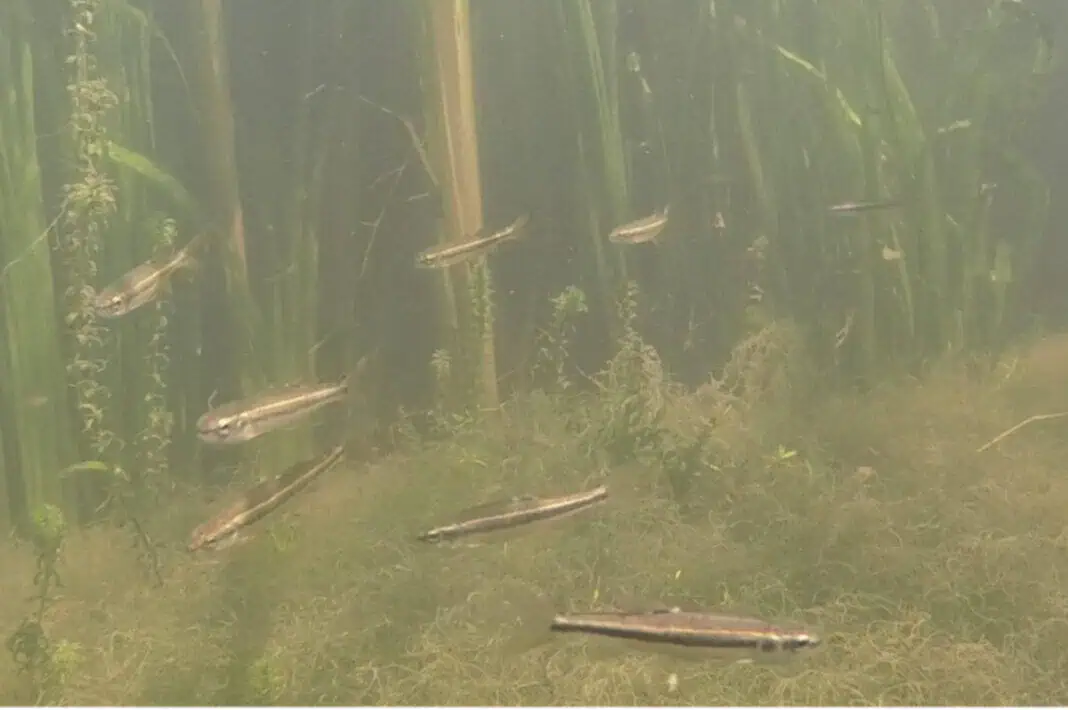
Researchers at the University of Bristol found that sticklebacks change their collective behavior to hunt effectively when visibility drops.
The finding sheds light on how aquatic life navigates degraded habitats.
The team published its findings in Proceedings of the Royal Society B, where they analyzed how three-spined sticklebacks adapted their shoaling formations as food appeared under varying water conditions.
Social Coordination Offsets Low Underwater Visibility
Turbidity caused by agricultural runoff, industrial mining, and shoreline construction frequently clouds waterways. Underwater visibility drops drastically, complicating basic survival tasks. The team found that while murky surroundings slowed individual reactions to food sources, fish in larger groups responded much faster.
In limited visibility, smaller groups successfully intercepted food faster by swimming in tight, parallel formations and aligning their paths. During the study, grouped fish showed increased coordination and heightened sensitivity to their neighbors before feeding, using collective movement to overcome severe visual limitations.
Flexible Group Rules
Corresponding author Christos Ioannou, Professor of Behavioral Ecology at the University of Bristol’s School of Biological Sciences, explained:
“When we put an unexpected piece of food in the water, it took the fish longer to find it when the water was cloudier. This makes sense and has been shown before in different water-living species. However, we were excited to see that the sticklebacks were able to compensate for this challenge by changing their shoaling behavior. Their shoals became more coordinated, with the fish moving and aligning themselves together much more closely in poor conditions. This in turn meant the fish were able to find the food faster than if they weren’t coordinating.”
Co-author Dr. Sean Rands, Senior Lecturer at Bristol, added:
“It’s interesting that the fish are changing their shoaling behaviour to match the environment. When we are studying grouping behaviour in animals, researchers often assume that there is a fixed set of behavioural rules that are used in all environments. Finding that these rules are able to change in response to the challenges animals experience is reassuring, as it shows that these little fish have some extra tricks for the changes that humans are causing to their homes.”

