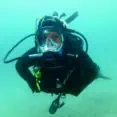


On my first night in Martinique, I ate lionfish ceviche to the sound of soothing surf and a man in short shorts pouring rum as if it were holy water. It was an introduction I hadn’t expected, especially on a dive trip.
If I had to describe Martinique in one word, it would be colorful. I arrived with little background, just an open palate, and what followed was a tasting menu of the island. Reefs and wrecks layered with history. Ti’ punch shared with strangers. Rainbows before volcanic peaks. Fishing villages humming with French-Creole rhythms. Coral gardens telling stories that span from volcanic catastrophe to modern conservation.
Located in the Lesser Antilles between Dominica and St. Lucia, Martinique is an overseas Department of France, rich in French-Caribbean culture, biodiversity, and geological drama. The island stretches 50 miles (80 kilometers) by 24 miles (39 kilometers), wrapped in 218 miles (350 kilometers) of coastline. The wild Atlantic, often swept by trade winds, shapes its east, while the western Caribbean offers calm bays, protected coves, and diverse dive sites just 5 to 40 minutes from shore.
Over a week, I sampled wrecks, reefs, and rum. What surfaced was richer than I imagined. Martinique isn’t just a place you dive; it’s a place you savor.
A Tale of Two Shores: South vs. North
South: Coral Kingdoms and Iconic Structures
The south of Martinique is a diver’s feast: white sands, reefs with turtles, rocky formations, and wrecks dressed in coral.
With Espace Plongée, we motor out from the marina at Trois-Îlets, past the twin coves Anse Noire and Anse Dufour, black and golden beaches divided by a rocky bluff. At The Little Mermaid, we slip into warm water alive with fish clouds and a grazing green sea turtle, though drifting stargasm reminds me that the sea has moods. It’s a calm, colorful checkout dive. Easy, unhurried, and a gentle welcome to the south. Smiles and Planteur (rum punch) seal the post-dive ritual, sometimes with white-spotted dolphin escorts.
But the true emblem of the South rises on the horizon: Diamond Rock. A volcanic spire once commissioned as a British warship, it’s now a protected site. Sunlight dances on its face, casting gemlike glints that give the rock its name. Yet its true brilliance lies beneath, where divers find the island’s most dramatic terrain.
Joining Canopée Bleue, we board a solar catamaran from the picturesque fishing village of Les Anses-d’Arlet. Colorful Creole houses and the church bells of Saint-Henri at our backs, we head toward Diamond Rock.
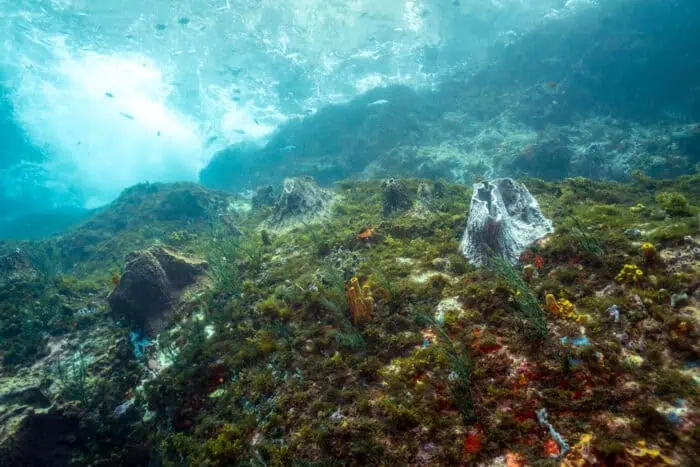
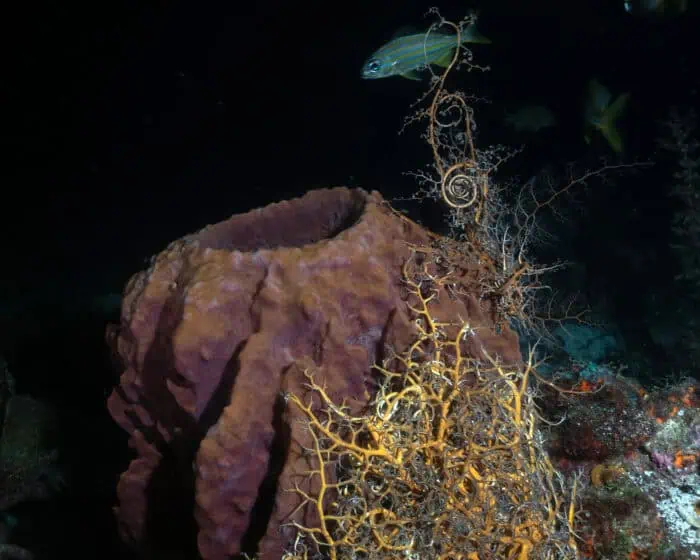
Its cliffs plunge as steeply underwater as they rise from the sea. Massive boulders and giant barrel sponges create an outer-space vibe, sea fans and corals filtering the surge as waves crash overhead. In the sand, the tiny yellowhead jawfish peek their heads out, while a black triggerfish unique to this site roams in the shallows.
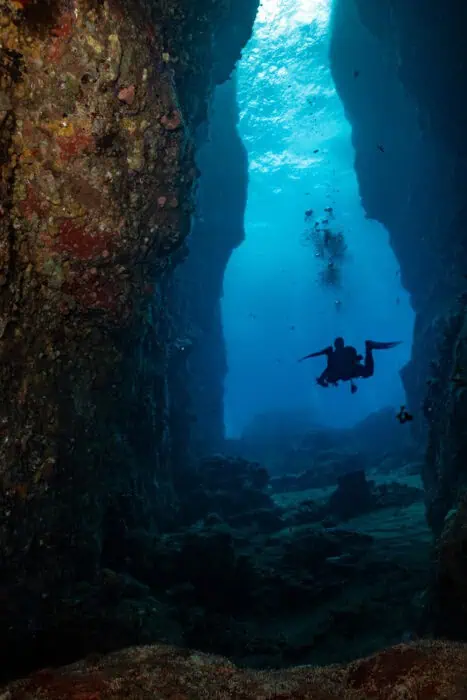
At 45 feet (14 meters), we reach the tunnel. A long, triangular cut through the rock glows with blue light that beckons us from 80 feet (25 meters) away. The slight current funnels through like breath from the rock itself.
Another must-dive is The Nahoon, a three-masted sailboat sunk in 1993 as an artificial reef. With O’ Fil de l’eau, whose beachside center in Anses d’Arlet puts us steps from the sea, we are on our way to the wreck I’d been waiting for all week.
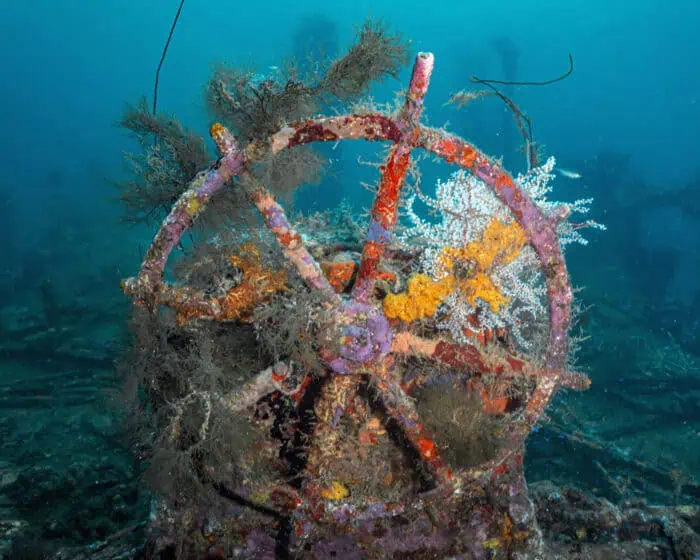
We follow the mooring line tied to the bow then, keeping her on her left, we trace her edge. The ocean’s blue eyes shine through the row of portholes. Whip corals spiral into tentacles, stretching from the yellow, pink, green, and orange hues so abstract they’d rival Kandinsky.
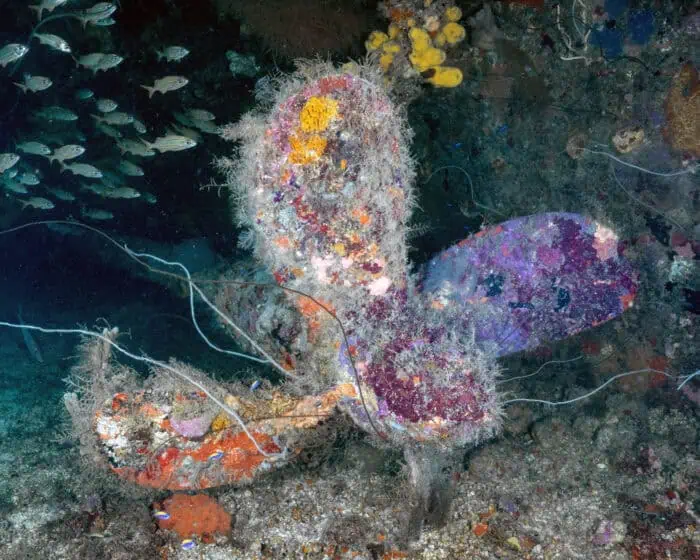
At the stern, 115 feet (35 meters) in the sand, we find the two propellers whose only movement now is the fish and critters circling them. Rising to the helm where crisscrossed steel, once a wooden platform, forms a tic-tac-toe grid. With hopes of spotting the resident moray eel, I nearly miss the classic steering wheel: a perfect photo op. We duck into the engine room before our no-deco limit reminds us that it’s time to ascend. Breaking the surface, the excitement pours out of our mouths before our regulators: “How [expletive] cool was that!!”
I imagine this would be an incredible night dive.
Around the bend of Grand Anse Bay, we get a night dive with Deep Turtle. I don a borrowed 3mm shorty, tighten my video lights, and watch the cliff glisten into twilight. We are at Golden Rock. We ascend only a few meters, yet the sea turns theatrical under darkness.
Our lights reveal snake eels weaving through seagrass, a basket star unfurling in slow motion, the lettuce-like nudibranch our dive master giddily points out. It is mesmerizing.
North: Wrecks in the Shadow of the Volcano
Where the south offers thriving reefs and surreal rock formations, the north tells the story shaped by ash, waves, and time.
It’s impossible to miss Mount Pelée. Rising 4,583 feet (1,397 meters), the volcano dominates the northern part of the island with its steep, green flanks and jagged ridges shaping both climate and biodiversity. At its base lies Saint-Pierre. It was once Martinique’s cultural and economic heart, a cosmopolitan referred to as “Little Paris” of the Caribbean.
That changed in May 1902.
That month, Pelée erupted with a violent pyroclastic flow, a high-speed avalanche of super-heated gas, ash, and debris that reached the city in minutes. Over 28,000 people were killed almost instantly. Nearly 400 vessels anchored in the harbor burned before sinking.
Official exploration began in the late 1970s, led by Albert Falco (chief diver and captain of Calypso for Jacques Cousteau) and renowned wreck hunter Michael Météry. Cousteau himself documented many of the expeditions. Their dives revealed not only maritime relics but valuable archaeological insights since the city’s official port records had perished in the eruption, leaving the sea as the last archive.
Today, the Memorial of the 1902 Catastrophe overlooks the bay. Walking through the beautifully curated museum, I pause at the melted artifacts, listen to the stories about the few survivors, and cruise the exterior esplanade where placards identify the dozen wrecks resting offshore. The Roraima, a 340-foot iron cargo ship, burned for three days before sinking to 160 feet (50 meters). Its engine room and corridors are eerily preserved. Another lies at 280 feet (85 meters) and was only identified by her bell inscribed with Tamaya 1862. Many of these wrecks rest too deep for recreational divers.
But not all.
One wreck we do indulge aquatically is The Amélie, a steel-hulled sailboat. Hauled offshore for maintenance during the 1902 eruption, she became a casualty of the volcano nonetheless, from a rogue wave.
We dive the The Amélie with DIAJ in Le Carbet. True to their name, Diving Is A Journey, the experience begins with a walk across the road to the dark sand beach under light rain. Offshore waits a solar-powered catamaran, the island’s first. Silent and clean, it aligns with the marine reserves they visit.
With flat seas, we glide to the site, which is also accessible by shore. The stern is at 10 feet (3.3 meters) and the bow dips to around 32 feet (10 meters), shallow enough for snorkelers to enjoy. Along the roadside, interpretive signs detail the ship’s history and surrounding marine life, complete with QR codes for on-the-spot species ID.
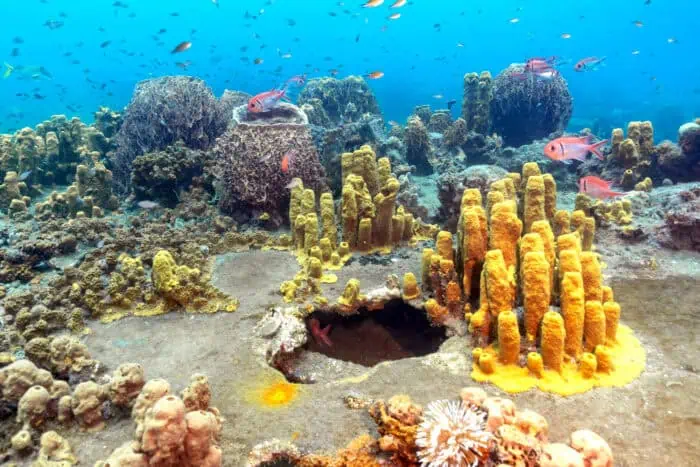
Four yellow buoys outline the wreck’s footprint. All fishing and anchoring are strictly prohibited here, and it shows. The scattered structure is now a vibrant reef exploding with corals and macro life of shrimp dancing on anemones, juvenile fish, spotted drums, crabs, and sponges blooming in bright clusters. Surrounded by a waving seagrass, it’s a miniature city beneath the surface.
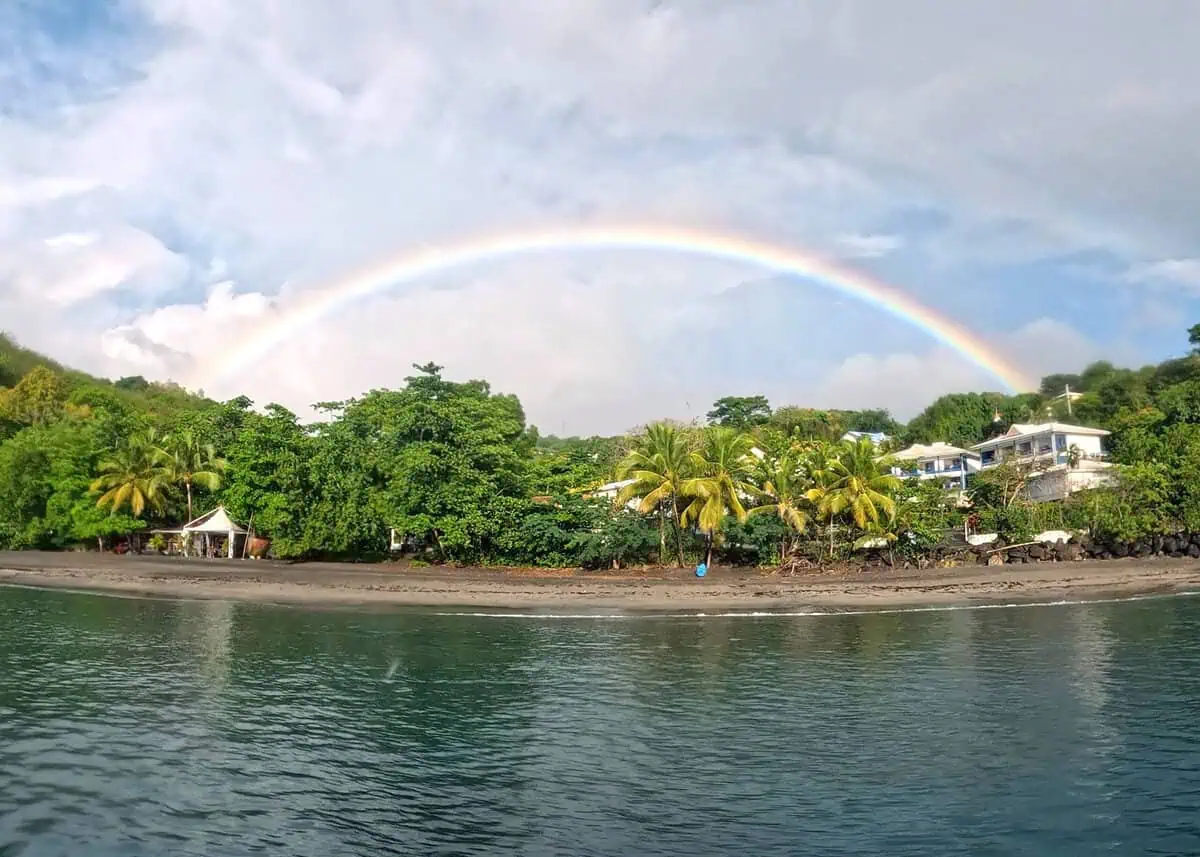
As we surface, the rain pelts the sea. A rainbow arcs over the shore, a fitting metaphor for Martinique’s culture: shaped by catastrophe but bursting with color and life.
Sustainability: Diving Forward
Not all of Martinique’s underwater stories are steeped in history. Some are unfolding in real time. In coral gardens patrolled by lionfish or from the decks of electric dive boats, redefining what sustainable diving looks like. Two dive operators have shifted to quieter vessels with fewer emissions and a gentler footprint.
UNESCO has recognized Martinique as a biosphere reserve and a cultural touchstone by honoring its land and sea biodiversity, volcanic geography, and even the traditional yole sailboat, still raced with pride around the island’s coast. The French AOC label protects its rum with the same care, a reminder that conserving identity matters as much as conserving reefs.
Even the sargassum that cloaks reefs and chokes shorelines during our visit is part of that living picture. A “golden rainforest,’ yes, but also a reminder that ecosystems are alive, dynamic, and demand adaptation.
Between Dives: Rum, Food, and Chef Hot Pants
Many highlights in Martinique surface on land in the food, culture, and the people who make it all unforgettable.
Take Le Petibonum, a beachside restaurant that looks half-abandoned when we arrive. Hours later, music spills from the speakers and the owner Chef Guy Ferdinand, known locally as Chef Hot Pants for his short shorts, holds court with lionfish and rum like it were performance art.
Lionfish aren’t unique to Martinique. For now, recreational lionfish hunting is unstructured, and efforts to manage populations are still emerging. But local chefs are already turning this ecological threat into something delicious, like silky coconut milk ceviche or stock for pumpkin soup.
Food in Martinique blends French finesse with Creole soul. Accras (cod fritters), le pêche du jour (catch of the day), fresh baguettes, and chocolate-drenched eclairs. And always, the national drink, Ti’ punch: white rhum, lime, cane syrup, simple and strong.
Martinique’s flavors run deep into the culture and the gravity of its history. Like much of the Caribbean, Martinique carries the weight of slavery. Its history is remembered in places such as the Savannah of the Slaves, an open-air museum honoring resilience, and the CAP 110 Memorial where white statues face the sea to commemorate the enslaved Africans that perished just offshore.
If diving introduced me to the island’s depths, these moments between dives revealed heart.
Not What I Expected, But Exactly What I Needed
Diving in Martinique felt less like following an itinerary and more like drifting with the current, unexpected turns, rainy surprises, and always something new just ahead. My French was clumsy. OK, truly, I did not understand anything. But underwater, the universal signs of SCUBA took over. Most dive shops and tourist sites offer several languages, including English, but the locals are warm and welcoming, so the language is just another layer of the cultural experience. And after a few dives and sips of rum, don’t we all speak the same language anyway?
I didn’t reach every site, La Perle, Babodi Canyons, or the deeper northern wrecks. But maybe that’s the point. Conditions shift, currents turn, ferry strikes happen. The beauty here isn’t filtered or predictable; it’s real and waiting.
By the end of the week, I was adding weights to my BC just to balance out the Ti’ punch and accras. Martinique, shadowed by a volcano and alive with reefs, is best enjoyed like a good meal … one bite at a time.
Good To Know
Getting There: Fly to Martinique Aimé Césaire International Airport (FDF) from mainland France, Canada, the USA (Miami), and nearby islands. Ferries connect Martinique with Guadeloupe, Dominica, and St. Lucia.
Currency: Euro (€)
Time Zone: Atlantic Standard (GMT-4)
Language: French & Martinican Creole; English spoken in tourist areas & dive shops.
Climate: Tropical and sunny 28°C-30°C (80°F – 86°F) year-round. Dry season (December-May) with lower humidity and little rain, though it’s the busy season. The Wet season (June-November) sees more rain and humidity.
Sea Temps: Around 26°C – 30°C (78°F – 86°F)
Diving: 33 professional dive centers*; options for all levels plus excellent snorkeling for non-divers; DIN fittings and metric gauges; on-island hyperbaric chamber.
* Several offer assistance with group bookings as well as accomodations.
Getting Around: Rental car recommended. Roads are well-kept. Distances can be long, but are scenic. Local ferries link Fort-de-France to other destinations across the bay.
Health & Safety: No required vaccinations. Bring sunscreen & bug repellent (the mosquito bites rival the Ti’ punch!)
Electricity: 220 V, European plugs (C/E)
More info: Martinique.org