
New Report: Where Bottom Contact Fishing Is More Intense, Life On The Seafloor Is Dramatically Reduced

A new study on Koko, a North Pacific seamount, found a clear pattern: where there’s more trawl damage and lost fishing gear, there’s less life.

-

A new study on Koko, a North Pacific seamount, found a clear pattern: where there’s more trawl damage and lost fishing gear, there’s less life.

Coral and sponge communities, which form the foundation of seamount ecosystems, are dramatically reduced, and recovery appears to be slow and uneven.

Scientists found that areas scarred by fishing gear had far fewer deep-sea corals and sponges, and the habitat was much less complex.

According to the Deep Sea Conservation Coalition:

“The findings of this study remind us that bottom contact fishing, including trawling, doesn’t just affect fish stocks, it leaves lasting scars and can reshape entire deep-sea ecosystems.”

After 60 years of bottom trawling, Koko seamount is now a patchwork of damaged and recovering areas, but pockets of untouched habitat remain, offering a glimpse of what a healthy deep-sea ecosystem once looked like.

Read the full study in Marine Environmental Research.
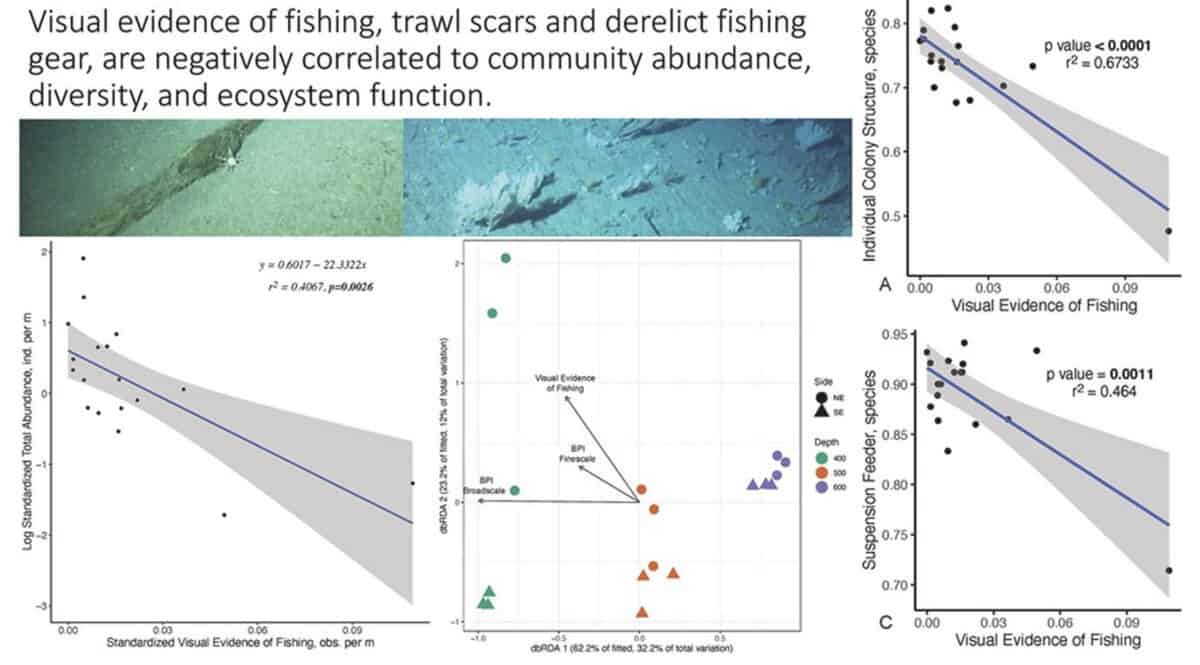
Bottom trawling (Image credit: Marine Environmental Research)
John Liang
John Lianghttps://www.deeperblue.com/
John Liang is the News Editor at DeeperBlue.com. He first got the diving bug while in High School in Cairo, Egypt, where he earned his PADI Open Water Diver certification in the Red Sea off the Sinai Peninsula. Since then, John has dived in a volcanic lake in Guatemala, among white-tipped sharks off the Pacific Coast of Costa Rica, and other places including a pool in Las Vegas helping to break the world record for the largest underwater press conference.

SEARCH

CONNECT WITH US

858,282FansLike
113,808FollowersFollow
2,738FollowersFollow
22,801FollowersFollow
13,177FollowersFollow
25,921FollowersFollow
2,531SubscribersSubscribe

RECENT ARTICLES