


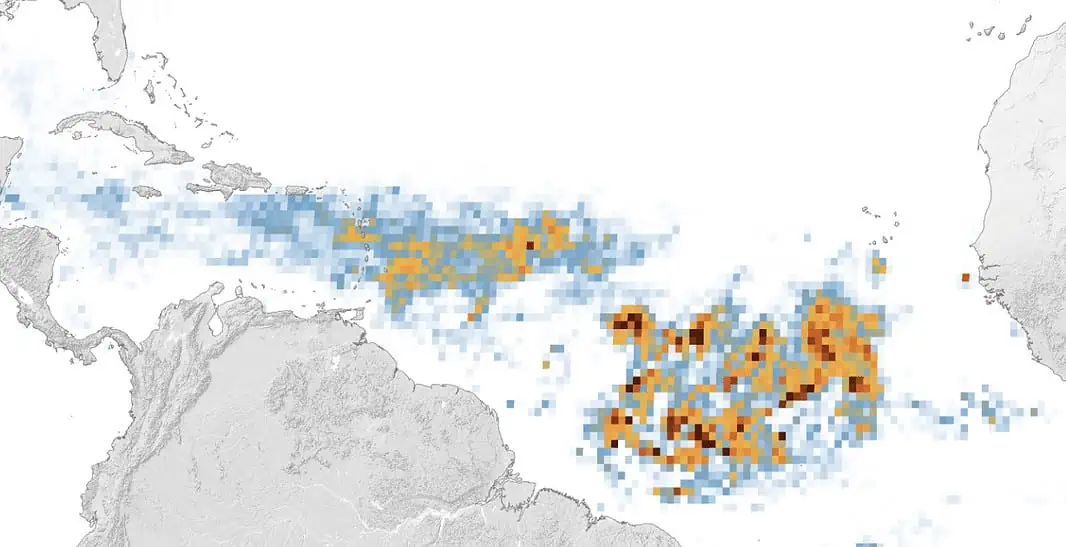
Researchers have traced the first major tropical Sargassum bloom to coastal waters off West Africa.
The research was carried out by a team from the University of Miami’s Rosenstiel School, working with other collaborators worldwide.
The research used a novel combination of physics-based drift modeling and probabilistic methods to show that the boom did not originate in the Sargasso Sea, but off the coast of Africa.
Commenting on the findings, lead author Francisco Beron-Vera, a research professor in the Department of Atmospheric Sciences at the Rosenstiel School stated:
“Sargassum blooms have had enormous ecological and economic impacts across the Caribbean, Gulf of Mexico, South Florida and West Africa…Our results provide strong evidence that these blooms begin in the eastern tropical Atlantic, not in the Sargasso Sea as previously thought.”
Beron-Vera added, describing the Sargassum movement patterns:
“Instead of treating the seaweed as a passive drift, the model represents it as clusters of floating ‘rafts’ influenced by ocean currents, winds and interactions between clumps. Thousands of simulated trajectories were then translated into a probabilistic framework using a time-varying Markov chain, allowing our team to reconstruct where the bloom most likely began.”
While co-author María Josefina Olascoaga, a professor in the Department of Ocean Sciences, added:
“These conditions appear to have provided the right combination of nutrients and ocean dynamics to trigger large-scale growth. Understanding the origin of these blooms gives us a much stronger foundation for predicting future events.”
You can read the original research published in PNAS Nexus for more information.

