


The Ocean Discovery League (ODL) today announced the launch of the Global Deep Sea Exploration Goals, an international effort to visually explore 10,000 strategically selected locations across the deep seafloor.
When completed, this initiative will nearly double the number of unique seafloor locations ever visually observed and produce the first globally representative visual dataset of the deep ocean floor.
These observations will unlock new discoveries about biodiversity, ecosystem function and environmental change, helping scientists, policymakers and the public better understand the largest and least explored ecosystem on Earth.
The methodology behind this strategy was published today in a Science Advances article titled “The Global Deep Sea Exploration Goals: A Representative Approach to Visually Observing the Deep Seafloor.”
The paper describes how the target locations were selected using existing global datasets of key seafloor characteristics and outlines the impact that observing these locations could have on achieving a representative picture of deep seafloor environmental diversity.
The initiative builds directly on ODL’s previous 2025 study, “How Little We’ve Seen: A Visual Coverage Estimate of the Deep Seafloor,” which revealed that only 0.001% of the deep seafloor has been visually observed despite covering more than half of the planet’s surface.
Ocean Discovery League President, National Geographic Explorer and senior author of the study Dr. Katy Croff Bell said:
“More than 99.999% of the deep seafloor has never been seen. The Global Deep Sea Exploration Goals provide the first practical roadmap to change that. By coordinating exploration efforts across the global community and focusing on locations that represent the true diversity of the seafloor, we can dramatically accelerate discovery while building a more inclusive and collaborative future for deep-sea science.”
Visual observations are one of the most critical non-invasive tools available to scientists, allowing researchers to document marine life behavior, assess biodiversity, provide context for collected samples, and characterize geological environments.
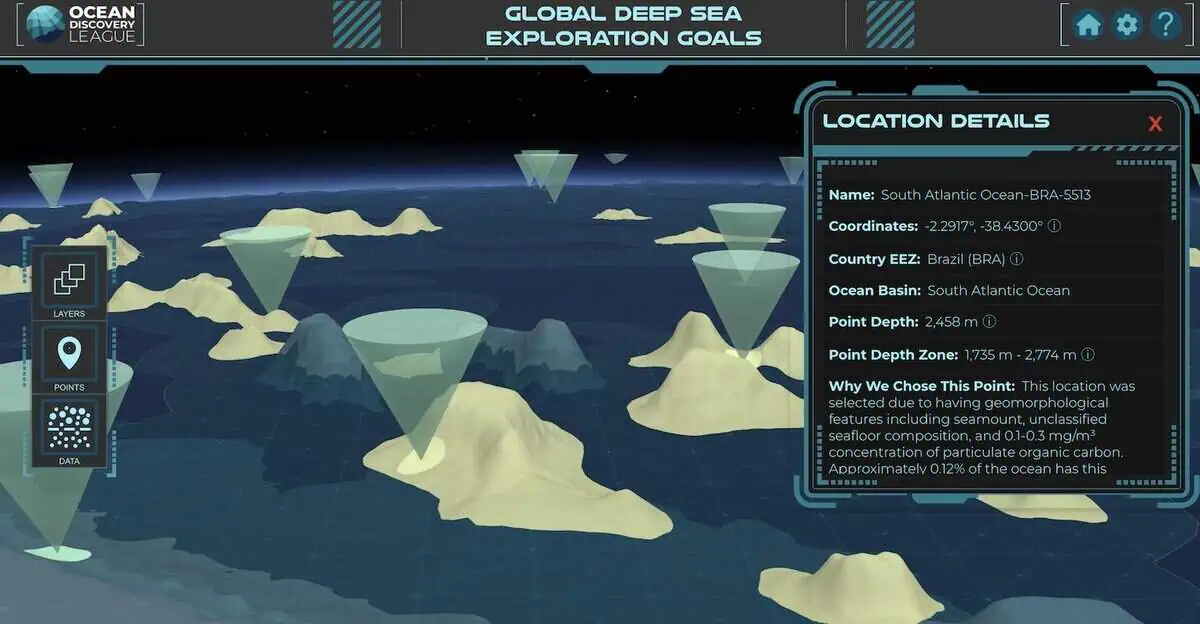
To support the initiative, ODL has launched an open-access interactive platform that allows researchers, expedition planners, and the public to explore the 10,000 targets and track progress as observations are completed.
Lead author Dr. Kristen Johannes said:
“By correcting for long-standing observational biases, such as disproportionate exploration near wealthy coastal nations or specific geological features, the approach provides a roadmap for a more representative, geographically balanced observation of the deep seafloor.”
A growing international coalition of organizations has already committed to supporting the Global Deep Sea Exploration Goals, including the National Geographic Society, Seabed 2030, OceanX, Schmidt Ocean Institute, Challenger 150, SpeSeas, LAMAVE, Marmoris, Oceanswell, and the Deep Ocean Observing Strategy (DOOS).

