


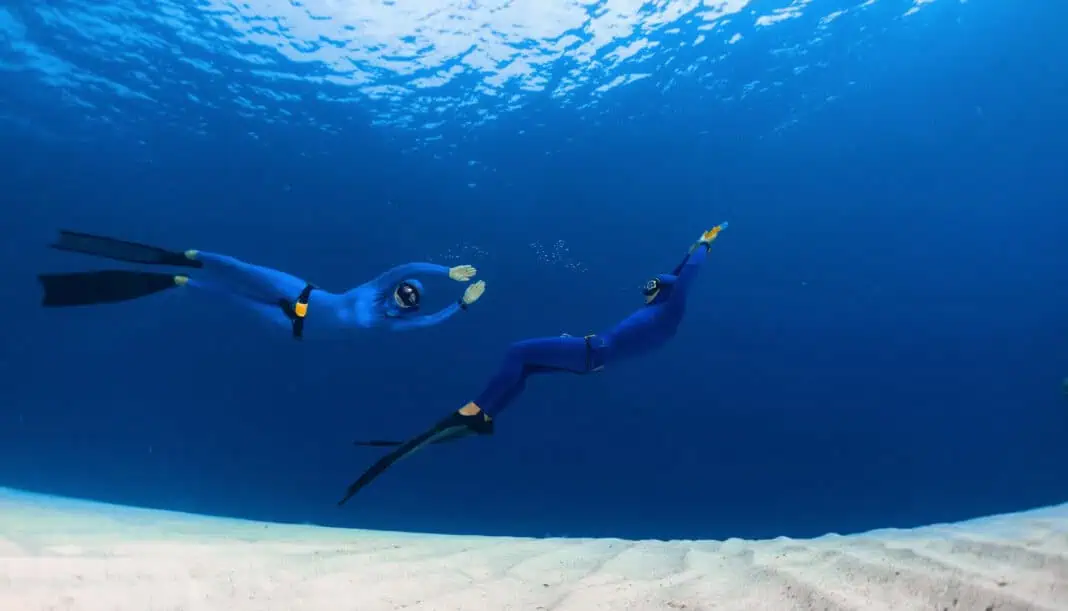
People think being a freediving instructor is a laid-back lifestyle, but honestly…it’s anything but! Some future instructors might be wondering what a “normal” day will look like. The honest answer is that there isn’t one, but there is somewhat of an outline to it. Join me, an AIDA Master Instructor/Molchanovs Wave 3 Instructor, as I walk you through a real one!
I’m teaching a level 1 course (which is either an AIDA 2 or a Molchanovs Wave 1) at my partner’s school, SaltyMind Freediving, in Xiao Liuqiu, Taiwan. My students are a couple: a man who’s a scuba diver and already comfortable in open water. His girlfriend is confident in the pool, but nervous in the wavy ocean where she can’t see the bottom. We already did theory previously, and both easily passed the static breath-holding session!
Morning Routine of a Freediving Instructor
At 7:30 am, the alarm goes off, and I remember that I’m not a morning person. I do a quick 15-minute stretch because my neck and back have strong opinions if I skip it, especially when I’m teaching.
The morning consists of a pool session, which means I’m allowed coffee (definitely not on depth days)! I cram down a tuna and egg sandwich I bought from 7-11 the night before, check for any messages from my students, and head to the shop to meet them at 8:30 am to gather gear.
Pool Session

Thank god it’s summer, and the weather outside is hot. It means I only need the top of my wetsuit, which means only half the struggle of getting it on.
We start with the basics: making sure they can properly wear and clear a mask and snorkel (mostly a refresher for my female student, who’s a little rustier here). Then the prerequisite swim of 100m or 200m, depending on whether it’s an AIDA or Molchanovs course, followed by a few surface laps in long bifins just to build comfort.
From there, we move into how to push off from the wall, neutral buoyancy checks, finning technique, and turns, then string it all together for the certification requirement. We close out the pool session with buddying and rescue practice, working through LMC and blackout scenarios. I make sure the girlfriend, who’s much smaller than her boyfriend, can hold him up and handle him well, since I know they’ll be diving together.
Lunch
My 2-hour lunch break consists of last night’s 7-11 run, and I’m thankful Taiwan 7-11s have so many healthy options. This is in large part because high season means the sit-down restaurants are packed with tourists, so a convenience store lunch is more of a survival strategy.
I hydrate (or try to), and squeeze in some writing work because, let’s be honest, freediving instructing alone doesn’t always pay the bills. I also reply to messages from a couple of prospective students asking about upcoming courses. Then I check the Windy app to figure out where we’re diving this afternoon. One of the small perks of a tiny island: if the wind is bad on one coast, it’s usually fine on the other.
Depth Session
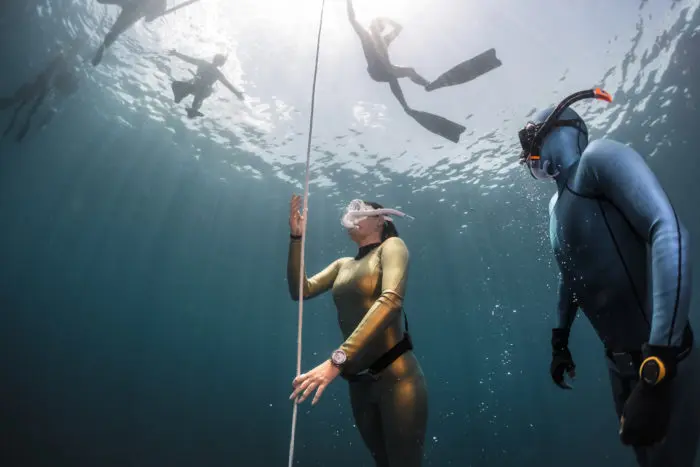
We hop on our motorbikes and head to Dafu, where conditions look kindest today. Then comes the least glamorous part of the job: the swim out. We have to venture 250 meters just to reach the 15-meter buoy, which is a challenge for the female student, so I keep her close to me and talk her through it. There’s some rolling swell and a little current, but the sun’s out, and my fingers are crossed that the current is going down rather than up.
We work through pulling down the line and equalizing. The male student picked it up almost immediately in the theory session, and it’s showing in the water, but the female student is still having trouble with her soft palate control. I tell her no worries; equalization is mostly worked on dry land, so we’ll spend some extra time in the evening on exercises with a balloon and EQ Trainer.
Duck dives go the same way, with the boyfriend finding it easy, and the girlfriend having a little trouble with body coordination. He nails it down enough to start working on kicking down the line, so I shift to adjusting his technique in the rising current, while his girlfriend continues working on duck dives.
Near the end of the session, she starts feeling seasick. Not surprising given the rolling swell and duck dives. I remind her to take seasick pills for the next open water session as I tow her back to shore, while she keeps struggling not to vomit. I’m suddenly looking forward to winter, when my partner and I will do our own depth training and drift diving off a boat in the Philippines.
Back on Land
I rinse the gear, hit the shower, and battle through the start of a headache. Note to self: drink more water next time!
My students head off to eat on their own while my partner and I grab a sit-down dinner at our favorite dumpling restaurant. At 7 pm, I meet back up with the students for an hour of EQ balloon exercises and a video review of their dives, and praise the ocean gods for good visibility and Instagram story material. However, I worry that the female student won’t pass unless she really practices equalization on her own tonight. I remind myself that I gave her all of the tools she needs, and now it’s up to her.
Back home, I answer a few more messages, wrap up the writing work I started at lunch, and fight tiredness while trying to catch up on Grey’s Anatomy, a show I am aggressively late to. I fall asleep quickly after a day of diving, knowing that tomorrow will be a similar version of this all over again.
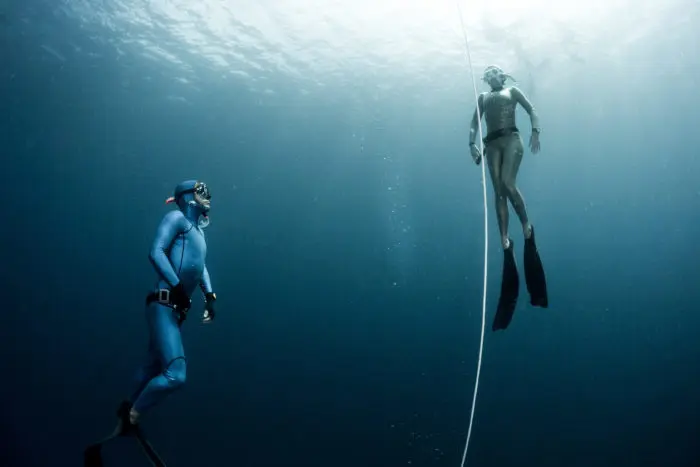
There you have it, a day in the life of a freediving instructor: some days it’s pure paradise, with sunny skies, a calm ocean, and lots of sea turtles! Other days, it’s challenging with rainy weather or cold from the wind. Sometimes, you’ll have too many students back-to-back and need a break, while slower slumps have you praying for more customers. Other times, you’re tired, but can’t “call off” work like you can in the office.
But for me (and most of my instructor friends), it’s the unpredictability and love for the ocean that make it interesting…and it definitely beats my old desk job!