


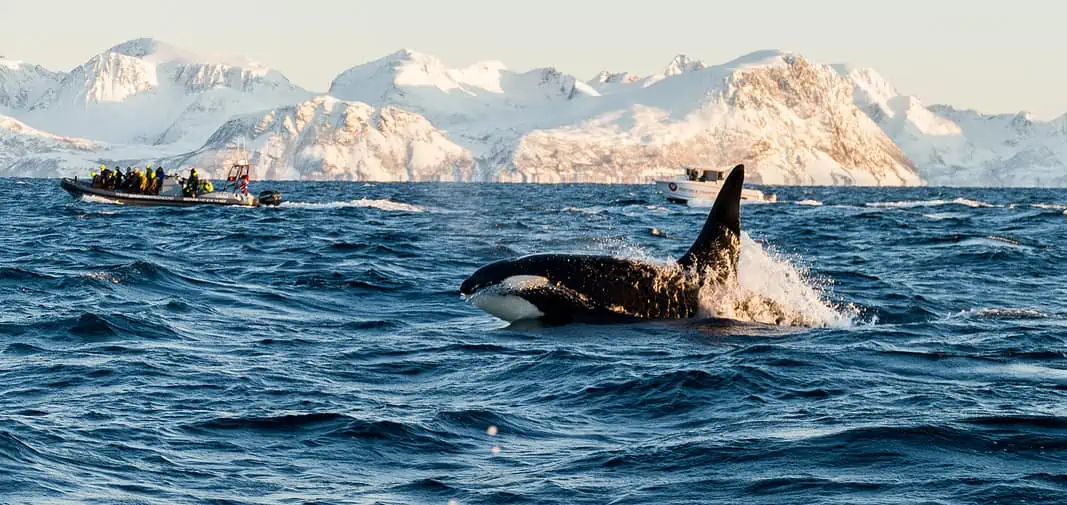
Scientists have documented multiple cases of orcas offering humans a wide range of food items.
In the study, researchers from Canada, New Zealand and Mexico reported on 34 interactions spanning two decades in which orcas in the wild attempted to offer food to humans. The incidents took place in oceans around the world, from California to New Zealand to Norway to Patagonia.
Several organizations participated in the research, including Bay Cetology, Orca Research Trust and Marea. The study was published in the Journal of Comparative Psychology.
In order to be included in the analysis, the incidents had to meet strict criteria — in each case, the whales had to have approached the people on their own (the people could not have closely approached the whales) and dropped the item in front of them. In all but one of the cases, the orcas waited to see what would happen after they made the offering, and in seven cases, they tried more than once to offer the food, after the people initially refused it.
The researchers wrote:
“Offering items to humans could simultaneously include opportunities for killer whales to practice learned cultural behavior, explore, or play and in so doing learn about, manipulate, or develop relationships with us. Given the advanced cognitive abilities and social, cooperative nature of this species, we assume that any or all these explanations for, and outcomes of such behavior are possible.”
Domesticated animals like dogs and cats sometimes offer food to humans, but this research marks some of the first detailed descriptions of similar behavior in nondomesticated animals. It makes sense, according to the researchers, because orcas are intelligent and social animals that use food sharing as a way to build relationships with kin and unrelated individuals. They also often hunt prey much larger than themselves, and thus sometimes have food to spare.
Commenting on the research, the study’s second author Dr Ingrid Visser stated:
“Orca are very social and we frequently see them food-sharing. To document and describe behavior of them attempting to food-share with humans in various places around the globe is fascinating.”
While the study’s third author, Vanessa Prigollini, added:
“Orcas are apex predators that often eat other large mammals, but when it comes to people, they occasionally prefer to share, indicating their interest in building relationships outside their own species.”
On the other hand, the study’s lead author, Jared Towers, commented:
“There appears to be a prosocial element to these cases indicative of interspecific generalized reciprocity, which is extremely unusual to witness in any non-human animal and is suggestive of evolutionary convergence between orcas and people.”
According to Dr Carl Safina, an author and ecologist who was not involved in the research:
“Of the many and varied minds in the sea, likely the greatest are those of orcas. Casual stories of their almost surreal intelligence abound. But here, these scientists have systematically gathered an impressive litany of instances where free-living orcas have shown that they possess ‘theory of mind,’ meaning that their minds understand that humans have minds too.
“Psychologists have often insisted that ‘theory of mind’ belongs only to humans. Orcas would beg to differ. Orcas have repeatedly sought to be interactive with us, and they are curious about us. After living millions of years in the sea, to them we in our boats must seem like visiting aliens. And, indeed, we are strangers in a strange place we hardly know, about which we yet have almost everything to learn.”

