


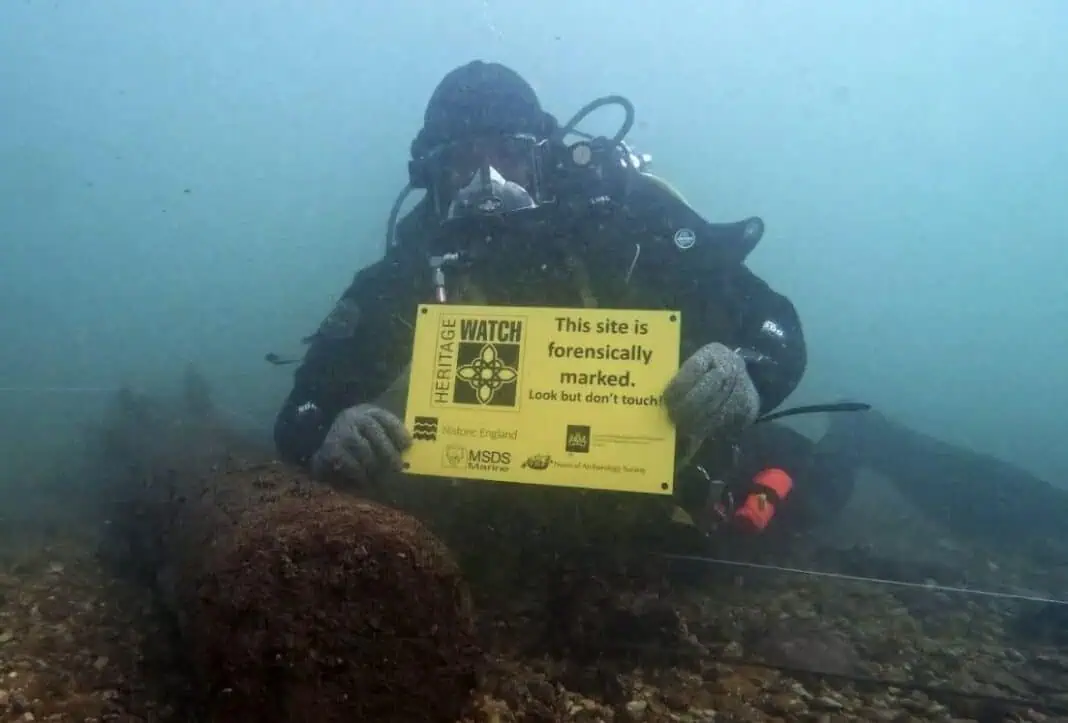
A new, recently released manual would make it easier for UK law enforcement agencies to detect and respond to crimes committed against historic shipwrecks.
The new “Common Enforcement Manual for Heritage Crime at Sea” was launched by Historic England and the University of Plymouth’s School of Law, Humanities and Social Sciences.
The guidance includes comprehensive legal advice and protocols for the observation, investigation and interception of vessels suspected of being involved in criminal activity, and outlines necessary communication procedures between relevant organizations.
The coast of England has 57 nationally important protected shipwrecks, 21 of which are located off Devon, Cornwall and the Isles of Scilly. Wrecks lying on the seabed present very obvious challenges for those monitoring them, so if crime or suspicious activity is detected on a protected wreck, those tasked with maritime enforcement need to be able to act swiftly.
According to Devon & Cornwall Police:
“While most divers abide by the law, an unscrupulous minority have removed material or failed to follow legal requirements, resulting in irreparable damage to several historic shipwreck sites.”
Rural Affairs Officer and Sergeant Julian Fry is the Heritage Crime Tactical Lead for Devon & Cornwall Police, and National Police Tactical Lead for Operation Birdie, which targets the illegal salvage or disturbance of protected wrecks.
Fry provided information for the policing section of the manual and attended the official launch of the document, which took place at Historic England’s head office in London on February 19th.
He said called the new manual a “game changer“:
“It provides clear and easy-to-use guidance that will help to ensure our maritime heritage sites are properly protected.
“Last year, the HMS Coronation, which went down off Rame Head, Cornwall in 1691 – and was added to the Protection of Wrecks Act in 1978 – was subject to potential damage after a series of lobster pots were found on the wreck in Cornwall.
“Preservation of nationally important heritage sites is essential and this pioneering manual which brings together into one place the knowledge, skills and experience of those involved with enforcement in the maritime heritage crime sector will help us to extend the protection for underwater heritage sites for years to come.
“The guide will be shared with Police, Coastguard, Border Force, Ministry of Defence and other key partners; outlining powers available to them to safeguard maritime heritage, as well as steps they can take to enforce protection laws.”
Historic England hopes this “one-stop-resource” for maritime heritage crime will enable law enforcement agencies to act quickly in response to suspected historical shipwreck crime incidents.
Historic England’s Head of Heritage Crime Mark Harrison said:
“Responding to heritage crime at sea requires swift action, clear procedures and the secure preservation of evidence.
“By strengthening awareness and coordination among the law enforcement agencies patrolling England’s waters, we are enhancing our collective ability to identify offenders, secure crime scenes, and protect historic wreck sites. This sends a clear message that criminal activity will not be tolerated.”
The manual was developed by Associate Professor of Law Jason Lowther and Visiting Professor Mike Williams, from Plymouth University’s School of Law, Humanities and Social Sciences, along with Beccy Austin, a senior consultant working for MSDS Marine.
They added:
“The Common Enforcement Manual is an unprecedented piece of joined-up action. It has active support from key agencies including the police, government and fisheries bodies and marks a major milestone in the protection of our rich underwater cultural heritage.”

