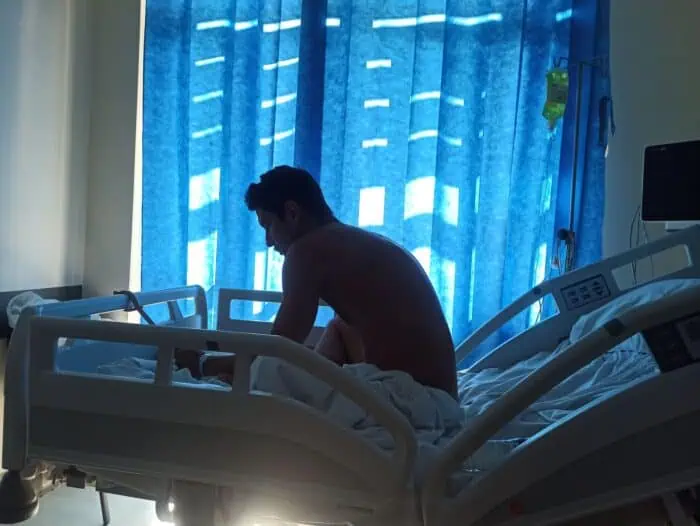


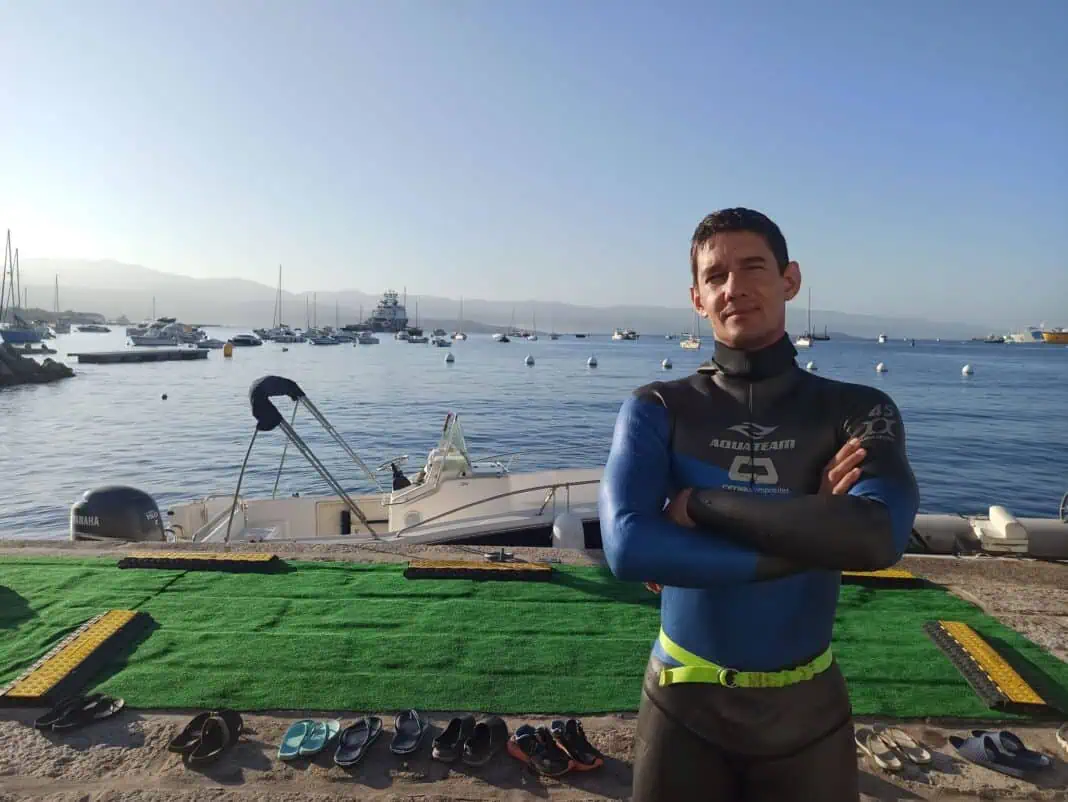
On September 6, 2025, during official training for the CMAS World Championships in Mytikas, Greece, Russian freediver Andrey Matveenko, aged 45, suffered a serious medical emergency following a constant weight (CWT) training dive. He was assisted to the surface by safety divers after losing consciousness during ascent and subsequently collapsed again at the surface. Matveenko was transported from the competition site to shore and later to medical facilities in Lefkada and Athens, where he underwent emergency treatment, including delayed hyperbaric oxygen therapy.
In the weeks that followed, Matveenko remained hospitalized and then entered rehabilitation, having sustained significant neurological injuries. Despite periods of partial recovery, he later died. His friend and colleague, Tatiana Zemskikh, has since released a detailed account of the events surrounding the incident and its aftermath.
The statements published below are English translations of first-person accounts provided by Andrey (prior to his death) and Tatiana Zemskikh. They were originally written in Russian and translated using professional translation services and AI-assisted tools, with care taken to preserve accuracy and meaning.
Editor’s Note: Any references to medical conditions, symptoms, diagnoses, or treatments within the accounts reflect the personal observations and understanding of the authors at the time of the events and should not be interpreted as clinical diagnoses, medical conclusions, or determinations of causation.
The CMAS World Championships are organized under the authority of the Confédération Mondiale des Activités Subaquatiques (CMAS), the international governing body for underwater sports including freediving. The 2025 championships in Mytikas, Greece, included multiple disciplines and involved athletes, safety personnel, and medical teams appointed under CMAS competition protocols.
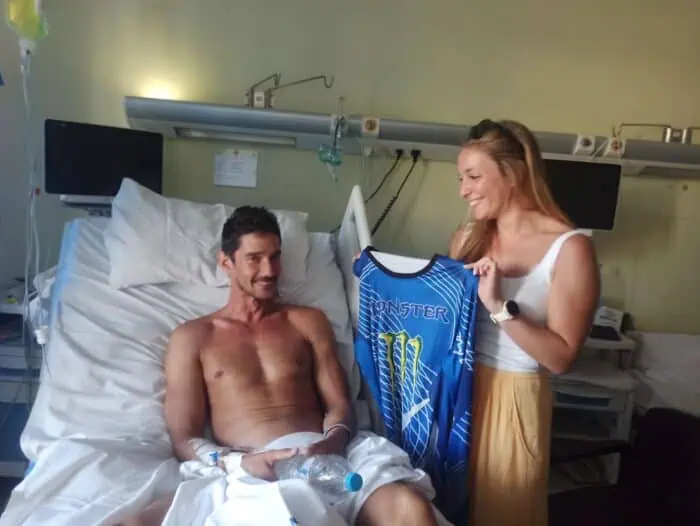
Andrey Matveenko Account
Andrey Matveenko’s account was written following the incident and prior to his death. It was provided to DeeperBlue.com via Tatiana Zemskikh and is published here in its original form, without edits or interpretation.
Editor’s Note: Tatiana Zemskikh is referred to as ‘Tatiana’ or ‘Tanya’ in Andrey Matveenko’s account, reflecting his original wording.
Incident Report for 06.09.2025 in Mytikas, Greece
On 06.09.2025, I was preparing for the Freediving World Championship in Mytikas, Greece.
That day I arrived at training on the organizers’ boat together with my coach Tatiana. The start location was organized unusually far from shore. And there was a thought that if the organizers had to evacuate someone, it would take a lot of time.
The start location consisted of two large boats. One was designated directly for athlete starts, the second was auxiliary for waiting and changing.
I changed and swam to the warm-up buoys, where I warmed up successfully. Then I returned to the auxiliary boat so I wouldn’t get cold. About 15 minutes before my start time, I swam to the start zone.
In the start zone, I prepared for the dive and dived. Based on sensations during the descent, the dive proceeded normally. Part of the ascent is not remembered.
On the surface, they did not provide me with oxygen, and therefore I decided that the dive was without blackout. Subsequently, it turned out that I had a blackout underwater at 15 meters (this is stated in an interview by CMAS to the Diving World portal).
The safety divers, without asking my consent and without providing me oxygen after the blackout (which is classified as severe), without examination by a doctor, dragged me toward the auxiliary boat. Effectively depriving me with their actions of the opportunity to do decompression on oxygen and avoid gas embolism.
The safety divers transported me toward the auxiliary boat. There was neither oxygen nor a medic at the transport point. The safety divers left me in the water, alone with Tatiana, despite the fact that climbing onto the auxiliary boat independently was difficult and uncomfortable, and I was after blackout, without breathing recovery with oxygen, and no qualified assistance was nearby.
After the safety divers swam away, Tatiana asked me how I was feeling. I answered that I seemed to be okay. And literally after a few seconds, I started to feel extremely dizzy. I asked Tanya to hold me because I was afraid of drowning. And I lost consciousness.
Next, I regained consciousness literally for a few seconds:
When they were loading me into the ambulance.
And when on the road I was so unbearably nauseous that I vomited directly into the oxygen mask. I was afraid of choking on vomit and was surprised that no one adjusted or cleared the vomit from my mask. I thought that no one was nearby, but it turns out the competition doctor was riding next to me.
Next, I remember some hospital where Tanya and the guys from the Spanish and Croatian teams tried to talk to me, but they weren’t allowed near.
Then several episodes of the road to Athens and the hyperbaric chamber.
I practically don’t remember the following days. The only thing I remember is the horror of being paralyzed. My right side wasn’t moving and wasn’t responding at all. I couldn’t do anything independently. And I was horrified by the prospect of living paralyzed.
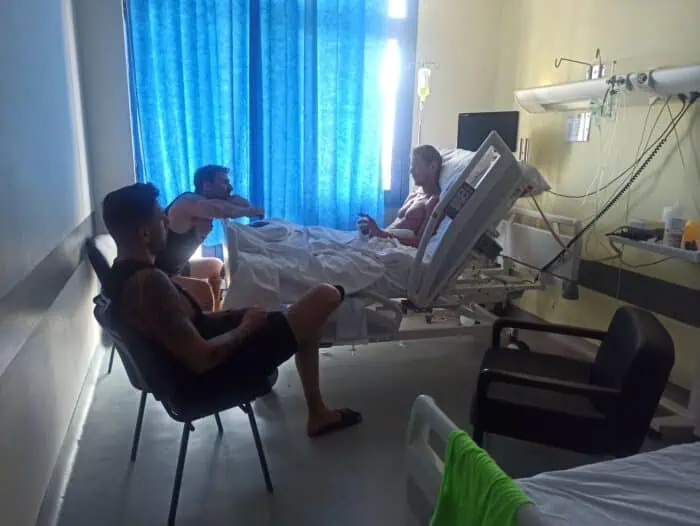
Tatiana Zemskikh Account
Friend and Colleague of Andrey Matveenko
The official training dive start for Andrey Matveenko CWT was at 11:20 AM, September 6, 2025.
Dive time: 4 minutes 4 seconds
Descent time: 1:57, ascent: 2:04
I was in the water at the surface and saw Andrey’s ascending from a depth of 25 meters (water clarity was good). He was ascending independently but was drifting away from the line. At some point, safety divers caught him and brought him to the surface. He wasn’t breathing on his own, didn’t respond to voice, and after a few seconds they gave him one breath through his nose and he immediately regained consciousness. There were no signs of barotrauma (such as blood or anything else). I looked underwater – both decompression lines with oxygen regulators were occupied (on one, Mateusz Malina was doing standard decompression after a deep dive 5 minutes before Andrey; on the second, Davide Carrera, who had dived 10 minutes before Andrey and, as we later learned, was showing signs of DCS). Therefore, there was no possibility to do standard decompression. The safety divers silently transported Andrey toward the location (to the left at the stern of the athlete boat) where before the start there had been a boat with a doctor and oxygen, and swam back to the start zone. But neither the doctor’s boat nor medical personnel were there. We were left alone in the water with Andrey. I asked how he was feeling, he answered “okay.” And after a few seconds said he was no longer okay.
He said, “Hold me, I’m going to drown.” And he lost consciousness. I kept him afloat. From the athlete boat, Nico Carleton jumped into the water to help me – as it turned out later, he even managed to take the monofin off Andrey. Several people helped from the swim platform. All together, in three attempts, we pulled Andrey out of the water onto the swim platform. There were no doctors or oxygen on the athlete boat. As it turned out later, the medical boat with personnel was near the oxygen lines at the stern of the start boat. Someone from the guys started shouting loudly from the athlete boat that we needed urgent evacuation right now. The medical boat arrived a few more minutes later (all this time Andrey was without oxygen and unconscious). When the medical boat approached the athlete boat, Dr. Giorgos Hadjigeorgiou’s assistant, climbed onto the athlete boat’s swim platform with an oxygen tank and placed an oxygen mask on Andrey’s face. After that, a few more minutes later, they threw him by his arms and legs into the medical boat. There were no stretchers. Andrey was unconscious and not moving the entire time. I managed to climb into the medical boat from the water. They placed Andrey on the bow of the boat in the sun, very uncomfortably. Then the medical boat returned to the start boat. I heard that we couldn’t leave for shore because Carrera was still underwater breathing oxygen. We waited until Carrera finished breathing and got on the boat. Only after that did we start toward Lefkada. From the deck of the start boat, many people were shouting that we needed to go urgently to the hyperbaric chamber.
The entire journey to shore, I held Andrey’s head and adjusted his arms and legs. The medics never moved him into the shade or removed his wetsuit. He lay in a very uncomfortable position. I tried to hold his head as comfortably as possible for him, but the doctor kept trying to bend his neck sharply forward. By that time, Andrey had regained consciousness, but he couldn’t move the right side of his body or speak. Throughout the entire ride, I repeatedly told the doctor that we needed to urgently take Andrey to the hyperbaric chamber, to which I repeatedly received the response from Giorgos Hadjigeorgiou:
“It’s a neurological condition and we’re taking Andrey to the hospital. We have a protocol and he doesn’t need the hyperbaric chamber.”
From Dr. Giorgos Hadjigeorgiou’s actions and words, it became clear that he was encountering such a situation for the first time and absolutely didn’t know what to do with the injured athlete. During the transport to shore, the medical assistant approached a couple of times, and from her actions it was also clear that she didn’t know what to do.
When the boat reached shore, an unpleasant surprise awaited us. There was NO ambulance!!! To my questions about when the ambulance would arrive, no one gave an answer.
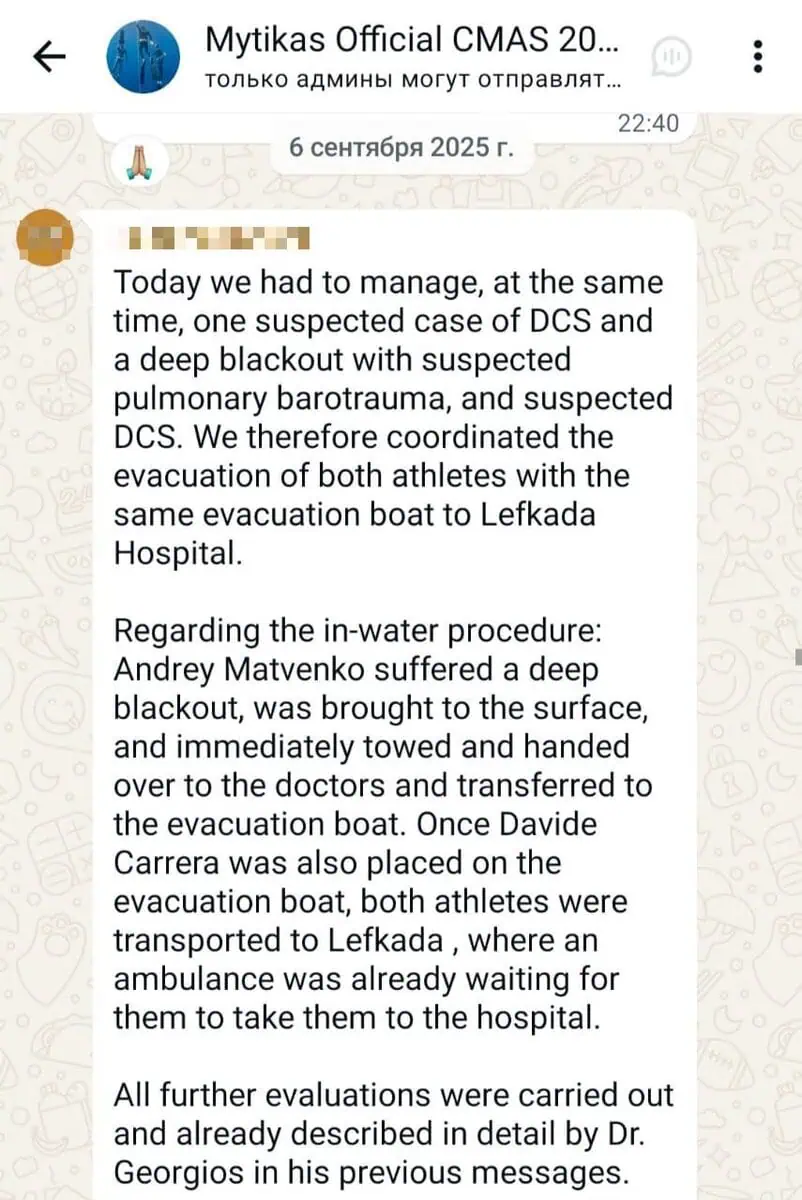
Andrey was still lying in his wetsuit in the sun; Davide was sitting under a canopy in the shade. I started removing Andrey’s wetsuit so he wouldn’t completely overheat. At this time, two men and a woman approached from a nearby moored boat. They introduced themselves as tourists from Germany and said that two of them were doctors, and asked how they could help. I briefly explained what had happened. Simultaneously with this conversation, they helped me remove Andrey’s wetsuit and the rest of his equipment so that the oxygen mask remained on him. About 12 minutes later, an ambulance arrived. The paramedics got out of the vehicle, brought a stretcher, placed it on the concrete pier, and that was it. They started scratching their heads and thinking about how to move Andrey. The German doctor, seeing the situation, took the stretcher, started commanding who should do what, and organized the process of transporting Andrey from the boat to shore himself. He told me to support Andrey’s head and that he was very worried about his brain. In the end, we managed with the stretcher and placed it in the ambulance. Unfortunately, the German doctors couldn’t help us any further.
In the end, Dr. Giorgos Hadjigeorgiou, the medical assistant, and Davide Carrera got into the ambulance with Andrey. They put me in the front passenger seat and I couldn’t see what was happening inside the vehicle. An hour had passed since the dive.
(As Andrey later told me: “I was vomiting into the oxygen mask, but they didn’t even clean it, and I was afraid I would choke on the vomit.”)
For those who don’t know, I’ll explain: one of the signs of brain damage is nausea and vomiting.
In my view, the medics’ behavior in this situation raises many questions.
In the end, more than an hour after the incident, we arrived at Lefkada Hospital. There was no hyperbaric chamber there.
Andrey was placed in the emergency department, connected to sensors, monitors, and oxygen supply. I was able to go in to see him several times to check his condition. He was speaking very poorly and was paralyzed on the right side.
I had neither a phone nor clothes, so I had no way to communicate with the outside world, unfortunately. Regarding questions about the doctors’ further actions, Grace assured me that a helicopter would arrive soon and Andrey would be transported to the hyperbaric chamber in Athens.
Dr. Giorgos Hadjigeorgiou disappeared somewhere and didn’t show up at all.
After some time following examination, they released Carrera from the hospital.
I was waiting for some action from the doctors regarding Andrey’s situation, but nothing was happening. No one explained anything. Dr. Giorgos Hadjigeorgiou didn’t appear and didn’t report on further actions.
About an hour later, Grace said that she, Carrera, and I would take a taxi to Mytikas. And Dr. Giorgos Hadjigeorgiou would stay with Andrey, assuring me that he was the best doctor and she trusted him.
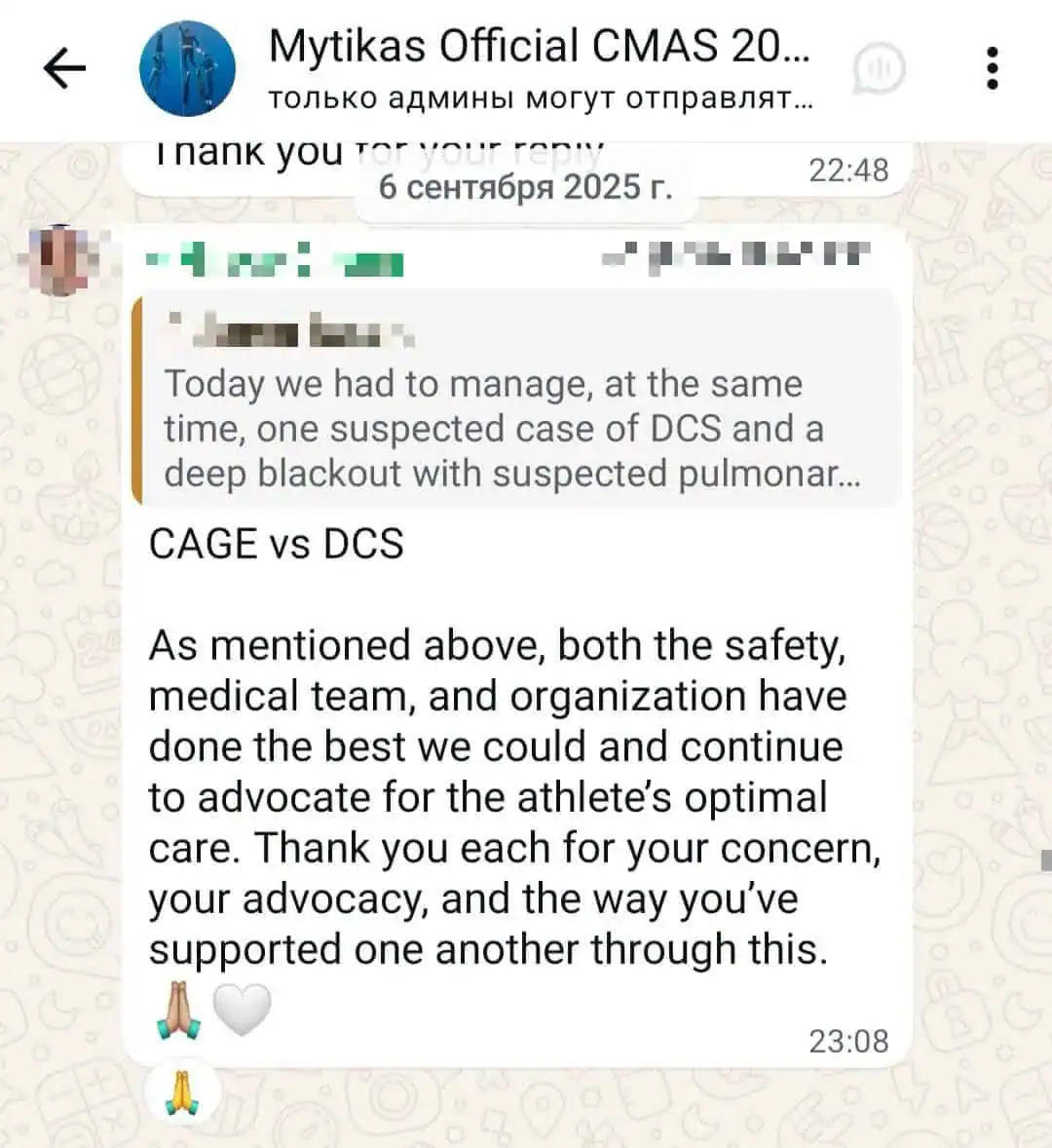
I decided I wasn’t going anywhere and went to Andrey. A couple of minutes later, Dr. Hadjigeorgiou came to see us. Seeing me, he started feeling for a pulse on Andrey’s arm and neck… despite the fact that Andrey was covered with sensors and all the data was displayed on a large monitor. The doctor’s behavior seemed strange for an experienced physician.
Twenty minutes later, guys from the Spanish team – Fran, Isabella, and their captain Natalie – arrived. They brought me clothes, bought shoes, and took me to eat. At this time, Grace and Carrera left for Mytikas.
In the hospital, we tried to get an answer to the question of when Andrey would be taken to the hyperbaric chamber. No one was saying anything. Andrey was just lying in the emergency room with an oxygen mask and sensors. To our insistent demands to send him to the hyperbaric chamber as soon as possible, we received no action. I asked the Spanish team guys to call Vitomir Maricic from the Croatian team and ask him to come to us, to also talk to the doctors and insist on placing Andrey in the hyperbaric chamber.
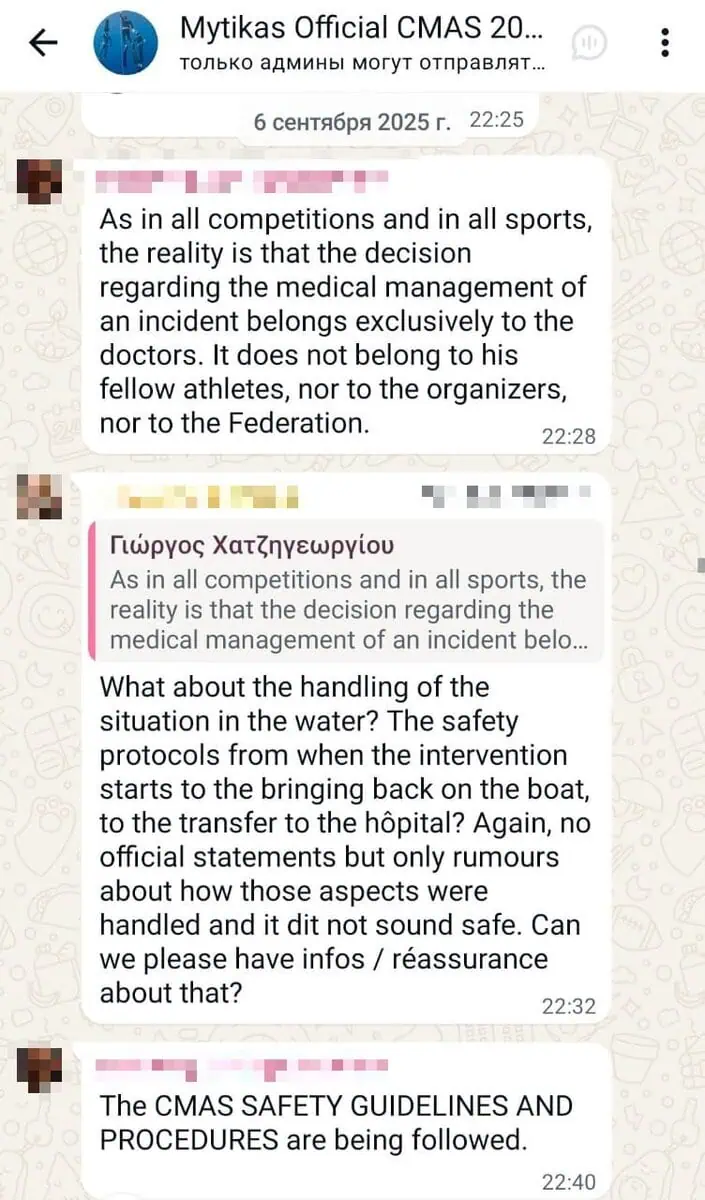
We stayed in the clinic and waited for at least some action from the medics. Dr. Hadjigeorgiou didn’t appear again. At some point, someone from Athens called the clinic reception asking whether to send a helicopter for Andrey. They called Dr. Hadjigeorgiou to the phone, and he replied that Andrey had a neurological condition and didn’t require a hyperbaric chamber or helicopter. We were bewildered by what was happening, but couldn’t do anything. Guys from the Croatian team arrived – Vitomir Maricic, Sanda Delija, and with them Mohammed Abdullah from the Qatar team; a little later Petar Klovar arrived with Zsofia Torocsik. They all also tried to convince the medics to send Andrey to the hyperbaric chamber, but to no avail. The guys started calling all the hyperbaric chambers they could reach themselves. This yielded no results. They called the insurance company DAN to consult on this case. At DAN, they were very bewildered that Andrey was being denied the treatment necessary for life and health – the hyperbaric chamber.
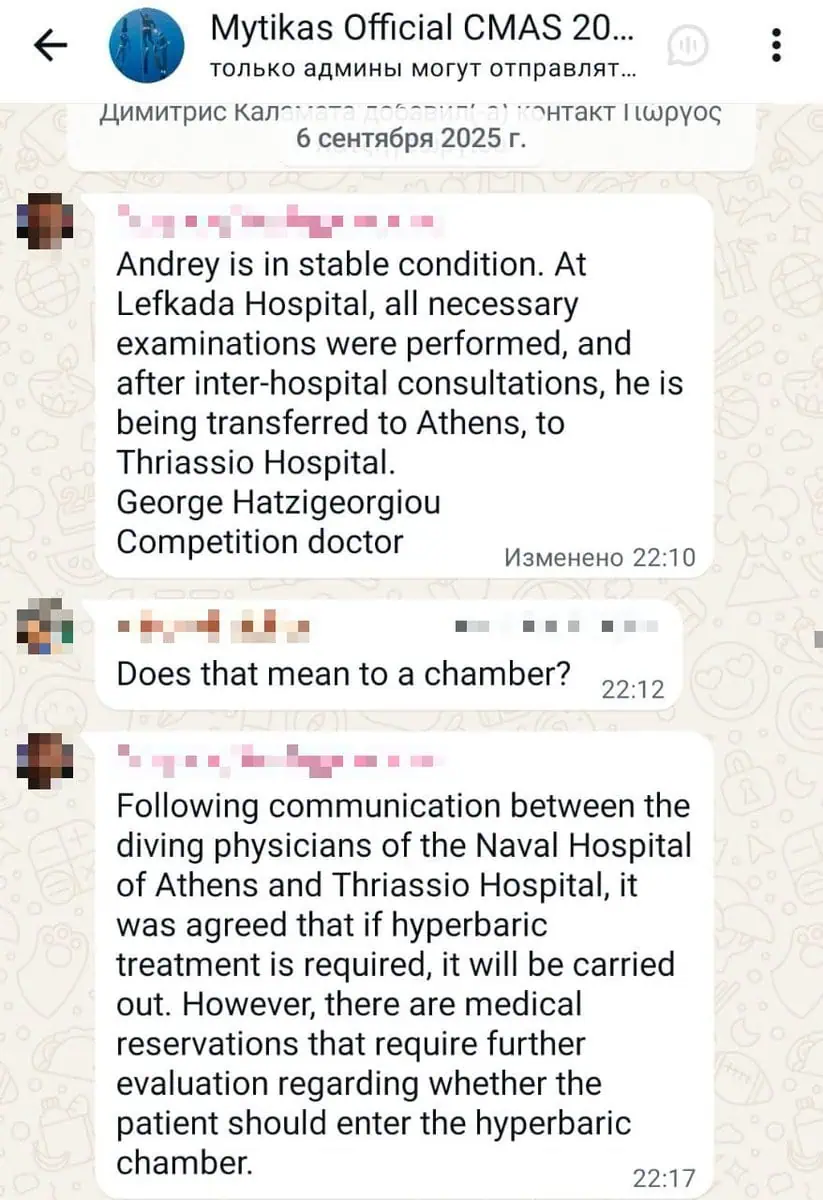
Nothing changed until dark. After seven o’clock in the evening, we were told that Andrey would be taken to Athens by ambulance (4 hours travel) and placed in the hyperbaric chamber. Vitomir and Mohammed went to Athens early to meet the ambulance; we stayed to wait for the ambulance. Around eight o’clock in the evening, two ambulances arrived and took Andrey. In Athens, Vitomir and Mohammed met him to make sure he would actually be taken to the hyperbaric chamber.
In the end, Andrey received his first hyperbaric chamber session almost 20 hours after the dive. The session was conducted using a light protocol. But it’s better than nothing.
After that, he was transferred to a regular hospital in Athens and we were told there would be no more hyperbaric chamber sessions.
Meanwhile, I briefly returned to Mytikas to collect our equipment, clothes, phone, and everything else. I managed to sleep for a couple of hours.
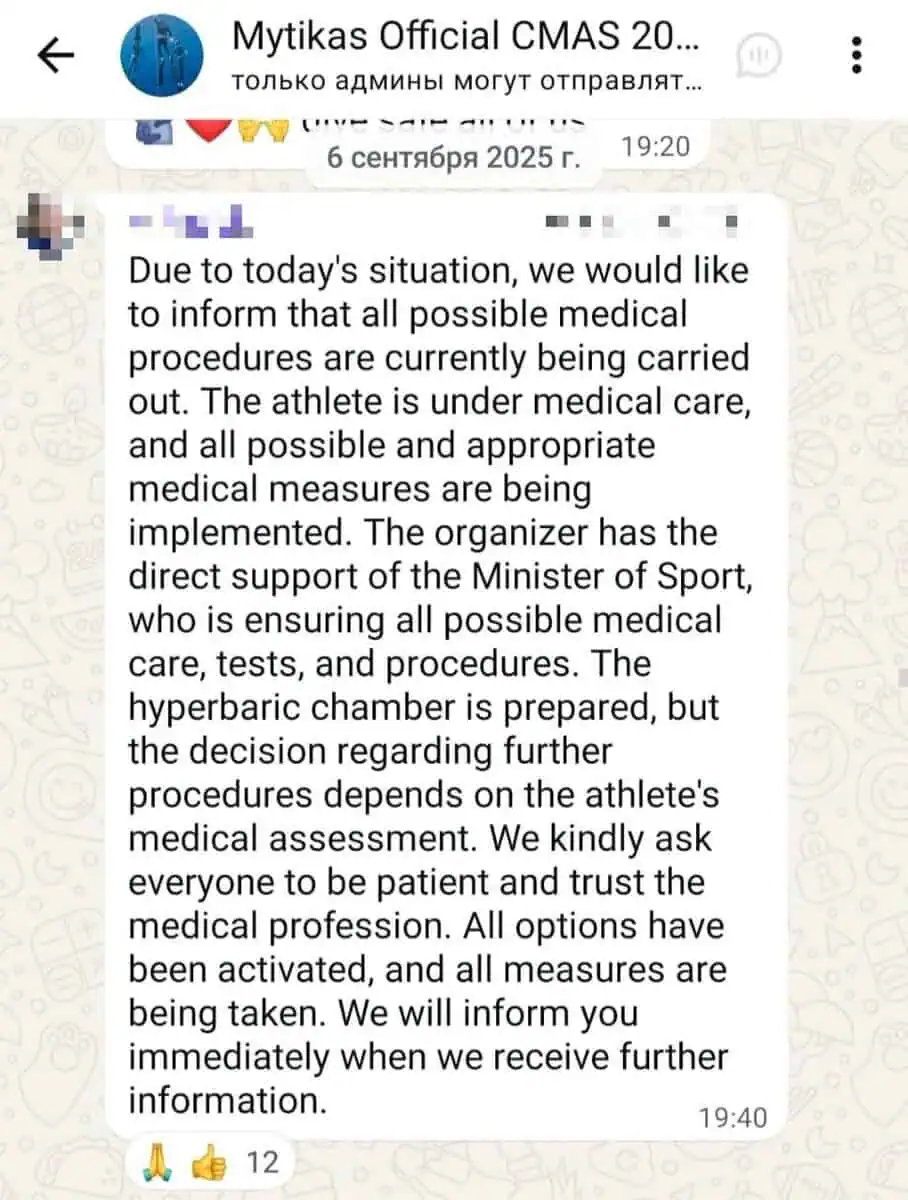
In the morning, we continued calling clinics with hyperbaric chambers and looking for ones ready to accept Andrey. Talya Davidoff and Maria Bobela joined this process. The first half of the day was spent on this. In the end, one of the hospitals in Cyprus was ready to accept Andrey. It was vitally necessary to do the second session within 48 hours. We, in the same group (Natalie, Sanda, Fran and me) plus Talya, went to Athens to pick up Andrey from the hospital and transport him to Cyprus.
While we were on our way to Athens, the situation around Andrey changed. The Naval Hospital unexpectedly agreed to admit him for treatment with daily hyperbaric chamber sessions. And since transportation in his condition was unsafe, we decided this option was safer for him. However, at first, for unclear reasons, they proposed to transfer Andrey to the Naval Hospital more than 48 hours after the incident. We insisted on transport at night. And in the end, Andrey received his second hyperbaric chamber session around midnight, on the night of September 7, 32 hours after the dive. At the Naval Hospital, they allowed one person to stay with him in the room for care. His condition was still extremely severe. The right half of his body was completely paralyzed. He was speaking very poorly and couldn’t move.
From the next day, Andrey received hyperbaric chamber sessions every day.
In the first days, Talya Davidoff and I stayed with Andrey in the hospital. Then I lived with him in the room alone, but Vitomir, Sanda, and Petar with Mohammed regularly came to visit us for several hours each day. We did many rehabilitation exercises with Andrey. The guys from the Spanish team also came several times to help us and provide support. After a week, Tolya Zaitsev (our colleague) arrived, and we continued care with reinforced numbers. Andrey gradually recovered with our help. He had extensive damage to the brain; the lesions were located in the frontal and temporal lobes of the brain and in the cerebellum. Recovery was predicted to be long (several years), but with the possibility of living a normal life. Competitive freediving, unfortunately, was no longer available to him.
He underwent 15 hyperbaric chamber sessions in the hospital. Andrey was very determined and diligently tried to do everything in his power for recovery. The care and treatment at the hospital were pretty average, but at that moment, it wasn’t the most important factor.
The competition organizers paid for the hospital stay and returned our entry fees for me and Andrey.
17 days after the incident, we took him to a rehabilitation center in Athens. This was all organized by our friends from Croatia with the assistance of Igor Barinov. Andrey had gradually started walking. He was very happy to finally leave the hospital walls and be able to sleep peacefully and start going for walks.
A new life had begun, but he was ready to work on himself.
The accounts presented document the sequence of events from the training dive on September 6, 2025, through emergency response, medical treatment, and subsequent care following Andrey Matveenko’s collapse during the CMAS World Championships in Greece. They reflect the personal recollections of Andrey Matveenko and Tatiana Zemskikh, his friend and colleague, and are published to provide an accurate record of their experiences.
DeeperBlue.com has previously published statements and responses from CMAS regarding safety procedures and medical provisions at the 2025 World Championships. Those materials remain available in our earlier coverage and are not reproduced here, as this article is intended solely to present the first-person accounts of Andrey and Tatiana Zemskikh.
DeeperBlue.com is publishing these statements in full and without editorial commentary. Responsibility for the content of each account rests solely with its author. The translations are provided in good faith to ensure accessibility for an international audience.