

History of Freediving is part of the Beginners Guide to Freediving
Freediving is as old as humanity’s relationship with the sea. For millennia, people have held their breath to dive for food, gather materials, wage war, or explore. What began as a necessity of survival has evolved into a sport that combines science, discipline, and adventure.
This chapter traces the arc of freediving’s history – from ancient sponge divers to modern world champions – and explores how humans continue to push the boundaries of physiology and performance underwater.
Key Takeaways
- Freediving dates back thousands of years, with records from Greece, Japan, Korea, and the Pacific.
- Divers once harvested sponges, pearls, and shellfish, or served navies as saboteurs and salvagers.
- The 20th century saw freediving shift from necessity to structured sport.
- Innovations such as masks, fins, and wetsuits transformed what was possible.
- Pioneers like Enzo Maiorca, Jacques Mayol, and Natalia Molchanova set the stage for today’s champions.
- World records now exceed 130 m (426 ft) in Constant Weight and 214 m (702 ft) in No Limits.
Ancient Freediving Traditions
In terms of our more recent history, we know for a fact that humans have been freediving for food for at least 8,000 years.
Archaeologists investigating the mummified remains of the Chinchorian, an ancient peoples that lived circa 6,000BC in what is today Chile, found them to have suffered from exostosis, the condition where the bones of the ear canal start to grow across the opening to help protect the eardrum from repeated exposure to cold water. It’s a condition known in modern parlance as ‘surfers ear’, though divers, surfers, and kayakers are equally likely to suffer from it – as is anyone who’s repeatedly dunked underwater.
The Chinchorian and their ilk weren’t freediving for pleasure, though, but for food and goods to trade. Pearls and sponges were among the first underwater items to find value amongst in-land societies and those without the skills with which to dive for them.
In 332 BC, Alexander the Great famously used freedivers to dismantle the underwater booms preventing his ships from entering the harbor during the siege of Tyre.
Greece and the Mediterranean
Some of the earliest written accounts come from ancient Greece, where sponge and pearl divers worked for trade and naval uses. Divers in the Aegean are recorded as early as 4,000 years ago.
- The “skandalopetra” stone – a flat rock weighing 8-14 kg – was used by divers to descend quickly, then hauled up by rope.
- Sponge divers in Kalymnos became famous for their skill, working at depths of 30 m (98 ft) or more.
Japan’s Ama Divers
In Japan, Ama divers (often women) have collected shellfish, seaweed, and pearls for over 2,000 years. Their tradition continues today, with some Ama still diving into their 70s. Dives are usually 5-10 m (16-33 ft), but can reach 20 m (66 ft).
Korea’s Haenyeo
Similar to the Ama, Korea’s Haenyeo (literally “sea women”) dive for abalone, octopus, and shellfish. They are renowned for communal work, songs, and rituals connected with the sea. Their practice is now UNESCO-recognised as intangible cultural heritage.
Pacific Island Cultures
In the Pacific, freediving supported fishing and navigation. Polynesian divers harvested food and practised long-distance swimming and breath-holding as part of exploration traditions. Stories of speardivers and reef hunters remain central in many island cultures.
Freediving in Early Records
- Homer’s Iliad (8th century BCE/BC): references warriors diving for sponges.
- Herodotus (5th century BCE/BC): describes the diver Scyllis, who cut Persian naval anchors.
- 2nd century CE/AD: Oppian’s “Halieutica” refers to sponge diving as a profession.
These references confirm freediving was both common and essential long before it became a sport.
Are we Aquatic Apes?
Some scientists suggest that humans may have evolved with a semi-aquatic phase — the so-called Aquatic Ape Hypothesis. The theory does not imagine gilled hybrids, but early hominids adapting to life in and around shallow water.
Wading upright would have freed the hands for gathering shellfish and seaweed while offering some protection from predators. A diet rich in protein and omega-3 oils may have supported rapid brain development.
Supporters point to several human traits unusual among primates:
- A layer of subcutaneous fat that provides insulation in water.
- Fingertips that wrinkle after immersion, improving grip underwater.
- The mammalian dive reflex, which slows heart rate and helps conserve oxygen.
Studies also show that human eyes can adapt for underwater vision if trained early, and that infants display innate aquatic responses – closing the airway and instinctively paddling when submerged.
While the hypothesis remains debated, it highlights just how deeply water is woven into our biology and behaviour.
Note: The Aquatic Ape Hypothesis is not universally accepted in evolutionary science. Many researchers argue that these traits can be explained by other evolutionary pathways. Still, the idea remains a popular lens for exploring our close connection to water.
Sponge Divers and The Birth Of Modern Diving
One of the most remarkable episodes in freediving history took place in July 1913. A Greek sponge diver named Giorgos Haggi Statti (sometimes recorded as Stathis Chatzi) was asked by the Italian Navy to help recover the lost anchor of the battleship Regina Margherita near the island of Karpathos.
Despite suffering from emphysema and partial deafness from years of diving injuries, Statti agreed. Using a skandalopetra stone for ballast and a rope tied around his waist, he descended between 77 and 88 m (253-289 ft) and stayed down for roughly three minutes. Against the odds, he located the massive anchor and was hauled back to the surface.
His feat was later confirmed by Italian naval records in 2001. For his success, Statti received a reward of £5 and lifetime permission to fish with dynamite – a telling sign of the era’s attitudes toward both resource use and diver welfare.
Although this story captured headlines, freediving at the time remained a tool of survival and commerce rather than recreation. Divers battled cold, poor visibility, and equalisation difficulties. It took a series of technological breakthroughs to pave the way for freediving as a modern sport.
Key Innovations That Changed Diving
- 1927 – Jacques O’Marchal: Designed the first mask that enclosed the nose, allowing divers to equalise ear pressure more easily.
- 1933 – Louis de Corlieu: Patented “swimming propellers,” the first recognisable fins. His design was later licensed to Owen Churchill, who mass-produced them in the United States.
- 1938 – Maxime Forjot: Filed a patent for a mask with a compressible rubber nose pocket, further improving equalisation.
- 1940s – Owen Churchill: Modified de Corlieu’s fins; the U.S. and British navies adopted them during WWII.
- 1951 – Hugh Bradner: Developed the first neoprene wetsuit, primarily for thermal protection. Though not immediately commercialised, it became the template for the dive and surf industries and was quickly taken up by the U.S. Navy during the Korean War.
The Naples Wager – 1949
The pivotal moment for modern freediving came in 1949. Italian Air Force captain Raimondo Bucher accepted a bet that he could reach 30 m (98 ft) in the Bay of Naples. At the time, scientists believed his lungs would collapse under the pressure.
Bucher surfaced unharmed and 50,000 lire richer. More importantly, he had disproved prevailing medical opinion and demonstrated that humans could adapt safely to depth. This dive is widely regarded as the birth of modern freediving as a sport.
From Innovation to Sport
Following Bucher’s success, freediving shifted rapidly from utility to passion. The 1950s and 60s saw the rise of a new generation of pioneers – Bob Croft, Jacques Mayol, and Enzo Maiorca – who pushed depth records, attracted media attention, and inspired scientific research. Their achievements brought freediving into the global consciousness and set the stage for the competitive sport we know today.

The Pioneers of Modern Freediving (20th Century)
With Giorgos Haggi Statti’s legendary 1913 dive and Raimondo Bucher’s 1949 wager laying the groundwork, freediving entered a new era in the second half of the 20th century. What had once been a tool of survival or commerce began to transform into an organised pursuit of depth, distance, and personal challenge.
The decades that followed produced a cast of extraordinary individuals whose ambition, rivalry, and philosophy defined modern freediving.
Enzo Maiorca – The Relentless Challenger
Italian diver Enzo Maiorca emerged in the 1960s as one of the first true freediving icons. A man of fiery temperament and competitive drive, he pushed record after record, breaking depth barriers and holding the world’s attention.
- In 1960, he achieved 45 m (148 ft), surpassing previous limits.
- By 1988, he had reached 101 m (331 ft) in No Limits diving.
Maiorca embodied determination. His rivalry with Jacques Mayol was the stuff of legend, their contrasting styles making headlines and later inspiring the film The Big Blue.
Jacques Mayol – The Philosopher of the Deep
French freediver Jacques Mayol brought a very different approach. A practitioner of yoga and meditation, he believed freediving was as much a spiritual practice as a physical one.
- In 1976, he became the first man to descend beyond 100 m (328 ft).
- He advocated that humans retained evolutionary adaptations — such as the mammalian dive reflex — linking us to our aquatic past.
Mayol’s philosophy resonated widely. He portrayed freediving not just as a competitive sport but as a way to explore inner calm and connection to the ocean.
Bob Croft – The American Depth Pioneer
Across the Atlantic, Bob Croft, a U.S. Navy submariner, was also rewriting limits. Experimenting with lung packing and equalisation techniques, he set world records in the 1960s, diving beyond 70 m (230 ft).
Croft’s work bridged science and sport. His dives informed physiological studies on lung capacity, oxygen management, and human adaptability at depth.

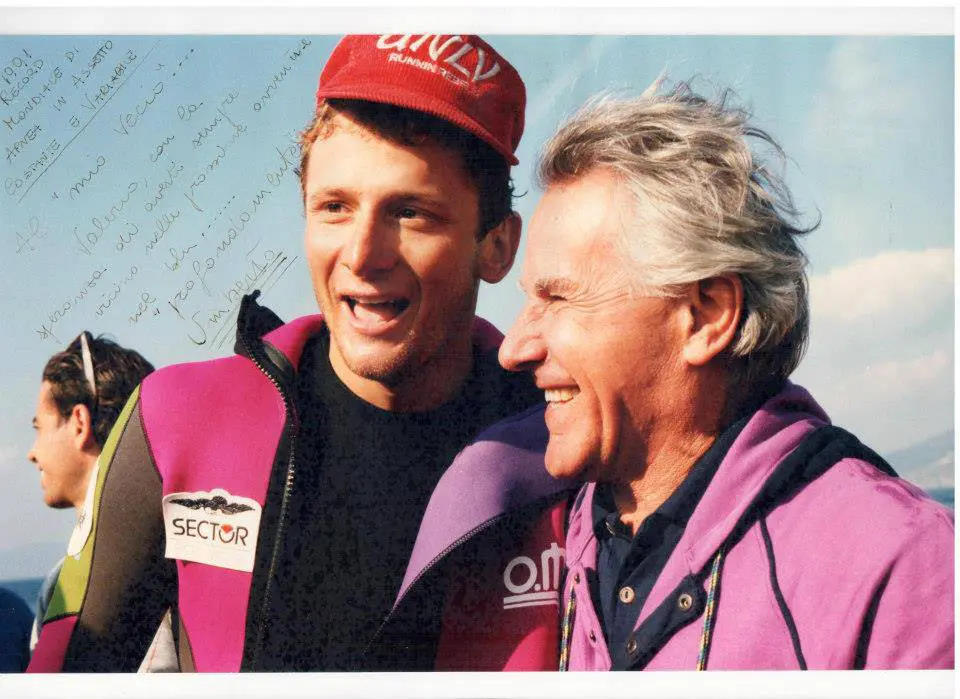
Umberto Pelizzari – The All-Round Champion
Italian freediver Umberto Pelizzari dominated the 1980s and 1990s as the most versatile athlete of his generation. He set world records in nearly every discipline, from Constant Weight to Static Apnea. His deepest dives included 150 m (492 ft) in No Limits (1999) and 131 m (430 ft) in Variable Weight (2001), before his retirement.
Beyond records, Pelizzari co-founded AIDA in 1994, establishing freediving’s first international rulebook, and later created Apnea Academy, a training system that remains central to education and safety. Featured in the IMAX film Ocean Men (2001), he became known as freediving’s intellectual ambassador, emphasising physiology, discipline, and safety.
Francisco “Pipin” Ferreras – The Cuban Showman
Cuban-born Francisco “Pipin” Ferreras rose to prominence in the 1990s as a specialist in No Limits diving. In 2000, he set a record of 162 m (531 ft), confirming his reputation as one of the boldest figures of the era.
Ferreras’ rivalry with Umberto Pelizzari defined a generation, contrasting Pelizzari’s precise, scientific approach with his own raw bravado. His career was later overshadowed by tragedy when his wife and diving partner Audrey Mestre died in 2002 during a record attempt. The incident, widely covered in international media, led to greater scrutiny of safety standards in extreme freediving.
Tanya Streeter – The Record-Breaking Woman
Born in the Cayman Islands and raised in Texas, Tanya Streeter redefined freediving in the early 2000s. On 17 August 2002, she set a No Limits world record of 160 m (525 ft) in Turks & Caicos, surpassing the men’s record under AIDA rules at the time.
Streeter went on to hold multiple records across disciplines, often eclipsing both women’s and men’s benchmarks. Her achievements brought freediving unprecedented media attention, and she later used her platform to promote ocean conservation and advocate for safe, ethical diving practices.

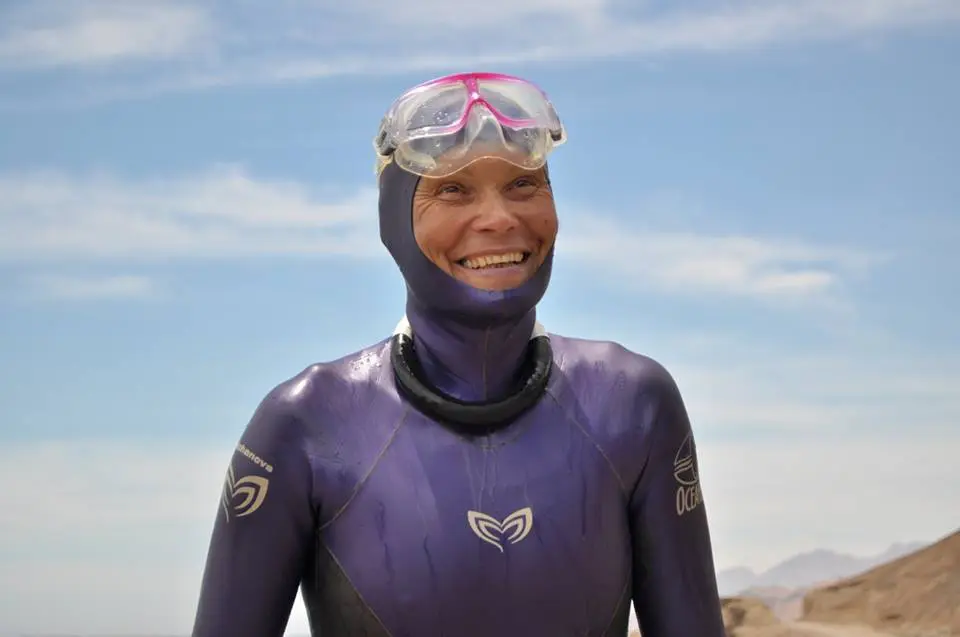
Natalia Molchanova – A New Standard for Women
From 2002 until her disappearance in 2015, Natalia Molchanova redefined what was possible in freediving. She set more than 40 world records, became the first woman to pass 100 m (328 ft) in constant weight, and built a reputation as both champion and teacher.
Her technical mastery and calm authority made her the sport’s most respected ambassador, inspiring a generation of athletes.
Legacy of an Era
The rivalries of Maiorca and Mayol, the scientific insights of Croft, the all-round excellence of Pelizzari, the drama of Pipin, the barrier-breaking feats of Streeter, and the dominance of Molchanova defined the 20th century.
Together, they transformed freediving from daring stunts into a structured sport with formal rules, training systems, and safety standards. Their influence shaped freediving’s identity — balancing ambition with responsibility — and set the stage for the contemporary champions who continue to push human limits today.
Contemporary Champions
The torch lit by Mayol, Maiorca, Croft, and Molchanova has been carried forward by a new generation of freedivers who continue to push human limits.
- Herbert Nitsch (Austria)
Known as “The Deepest Man on Earth,” Herbert Nitsch has achieved 33 world records across nearly every freediving discipline. His most famous dive came on 14 June 2007, when he descended to 214 m (702 ft) in the No Limits (NLT) category off Spetses, Greece — still the deepest officially recognised dive in history.In 2012, Nitsch attempted an unprecedented 253 m (831 ft). Severe decompression injuries prevented official ratification, but the attempt cemented his place as one of the boldest figures in freediving history. - William Trubridge (New Zealand)
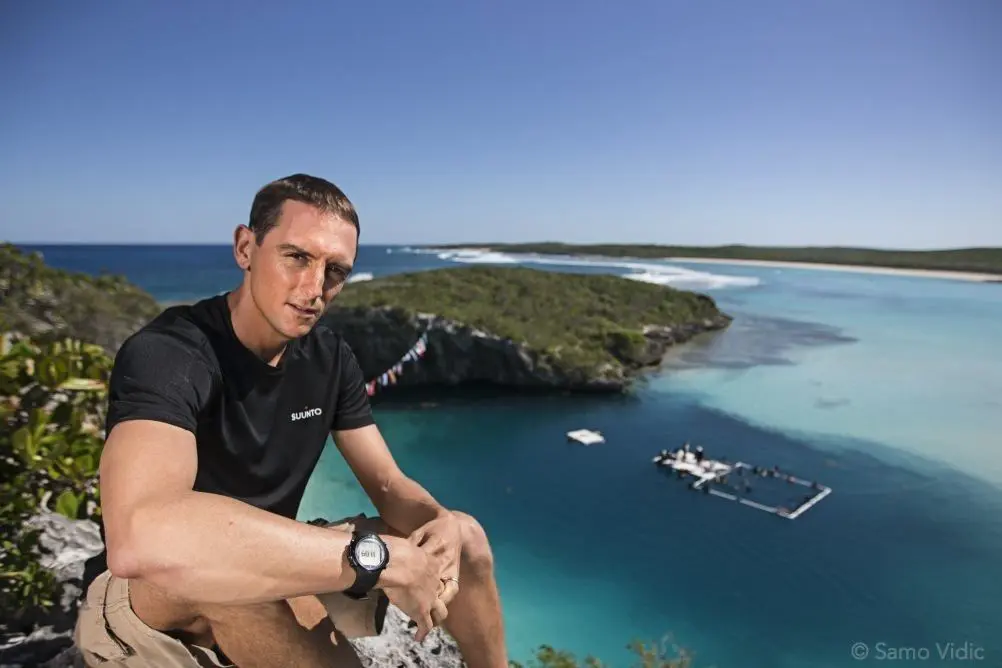
A specialist in Constant Weight No Fins (CNF) – often regarded as the sport’s purest and most demanding discipline – Trubridge became the first diver to break the 100 m (328 ft) barrier in CNF in 2010. He later pushed the CNF record to 102 m (334 ft) in July 2016 at Dean’s Blue Hole, Bahamas.His achievement stood until May 2025, when Croatia’s Petar Klovar reached 103 m (338 ft). Beyond records, Trubridge has been a tireless advocate for safety, ocean conservation, and raising freediving’s profile on the world stage. - Alexey Molchanov (Russia)
Son of the late Natalia Molchanova, Alexey has become the most decorated freediver in history, with over 40 world records across multiple disciplines.
– Constant Weight (CWT): In 2023, he reached 136 m (446 ft) in Limassol, Cyprus – the deepest CWT dive ever.
– Constant Weight with Bifins (CWTB): Multiple records beyond 120 m (394 ft).
– Free Immersion (FIM): Holds several of the world’s deepest performances.
As of 2025, Molchanov remains the undisputed leader in depth disciplines, continuing to push the boundaries of human physiology and technique.
Together, these contemporary champions highlight how far freediving has progressed in only a few decades. Where scientists once believed depths beyond 30 m were fatal, athletes today regularly exceed 100 m (328 ft) with refined technique, training, and safety protocols.
Latest Highlights (2023-2025)
- CNF: Petar Klovar (Croatia) – 103 m (338 ft), May 2025.
- CWT: Alexey Molchanov (Russia) – 136 m (446 ft), 2023 (still standing).
- No Limits: Herbert Nitsch (Austria) – 214 m (702 ft), 2007 (unbeaten).
A Timeline of Freediving Milestones
- ~3000 BCE – Ancient Mediterranean: Sponge and pearl divers recorded in early Greek and Middle Eastern sources.
- 8th century BCE – Homer’s Iliad: Mentions warriors diving for sponges during the Trojan War.
- 5th century BCE – Scyllis of Scione: According to Herodotus, the Greek diver sabotaged the Persian fleet by cutting anchor lines underwater.
- 1913 – Giorgos Haggi Statti (Greece): Descended between 77-88 m (253-289 ft) to recover the Italian battleship Regina Margherita’s lost anchor near Karpathos.
- 1949 – Raimondo Bucher (Italy): Won a wager by diving to 30 m (98 ft) in Naples Bay, disproving claims that such depths were fatal.
- 1960s – Enzo Maiorca (Italy): Repeatedly broke depth records, surpassing 50 m (164 ft) and pushing freediving into public view.
- 1976 – Jacques Mayol (France): Became the first person to reach 100 m (328 ft), combining yoga and meditation with technique.
- 1988 – Enzo Maiorca: Returned to the spotlight with a dive to 101 m (331 ft).
- 1960s-70s – Bob Croft (USA): U.S. Navy submariner set records beyond 70 m (230 ft), contributing to physiological research.
- 2002-2015 – Natalia Molchanova (Russia): Set over 40 world records, first woman beyond 100 m (328 ft), widely regarded as the greatest female freediver.
- 2007 – Herbert Nitsch (Austria): Achieved 214 m (702 ft) in No Limits off Spetses, Greece — the deepest officially recognised dive.
- 2010 – William Trubridge (New Zealand): First diver to break 100 m (328 ft) in Constant Weight No Fins (CNF).
- 2016 – William Trubridge: Extended CNF record to 102 m (334 ft) at Dean’s Blue Hole.
- 2023 – Alexey Molchanov (Russia): Set the Constant Weight (CWT) record at 136 m (446 ft) in Cyprus.
- 2025 – Petar Klovar (Croatia): Set a new CNF record of 103 m (338 ft), surpassing Trubridge.
Science and Physiology
The mid-20th century brought scientific insight into freediving:
- Mammalian Dive Reflex was studied, showing bradycardia and blood shift as adaptations.
- Equalization techniques such as Frenzel and Mouthfill were refined.
- Understanding of barotrauma and squeezes improved training safety.
This combination of science and sport transformed freediving into a modern, legitimate discipline rather than a dangerous stunt.
Freediving Today
Freediving is now practiced globally:
- Recreational freedivers explore reefs, wrecks, and caves.
- Competitive freedivers train for world championships under organisations like AIDA and CMAS.
- Underwater photographers and filmmakers use freediving for natural interaction with marine life.
- Traditional communities (Ama, Haenyeo, Polynesian divers) continue their heritage.
The sport grows every year, supported by courses, clubs, and scientific research.
FAQs
Who was the first person to dive 100 m?
Jacques Mayol in 1976, at Elba, Italy.
Who is considered the greatest freediver?
Many regard Natalia Molchanova as the greatest, with over 40 world records and unmatched influence as an athlete and teacher.
Why are Italy and France so important in freediving history?
They produced many early pioneers (Maiorca, Mayol) and hosted record-setting dives that shaped the sport’s development.
What is the deepest freedive ever recorded?
Herbert Nitsch’s 214 m (702 ft) No Limits dive in 2007 remains the deepest officially recognised dive.
Further Reading
Previous Chapter | Back to Beginners Guide to Freediving | Next Chapter